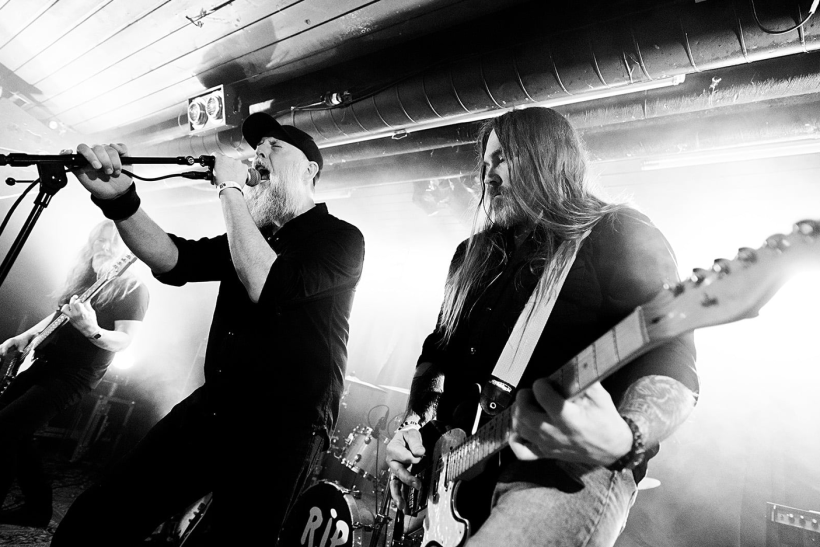
We recently had the chance to speak with the fine gentlemen behind Norway’s Avrak about their self-titled debut album. A devotional work dedicated to the spirit of classic hard rock and heavy metal, Avrak bears the character of its two leading lights: scene veteran Anders Hegna and none other than Nocturno Culto himself, Darkthrone’s Ted Skjellum.
The project, also featuring Terje Kråbøl on Drums and Steinar Gundersen on bass, gives the listener a fresh, energetic and powerful experience of heavy rock and roll — played by expert craftsmen but still maintaining a spontaneous and unrefined edge. And that’s exactly what the band is going for, as you can tell from our discussion below. It was fascinating to talk to both Ted and Anders about how they got started, how they went about recording the album, and what inspired them along the way. You might be surprised by a couple things, so read on!
(Note: The interview below has been lightly edited for clarity.)
—
Thank you for agreeing to talk with Decibel today! Could you tell me how the project came together?
Anders: We’ve talked about it a couple of times now, but we’ve known each other for like 10, 12 years or so on a private basis. And so a couple of years ago, we talked about how we should do something together musically. I, of course, knew Ted as a musician and he’s been to some of my concerts. And we just thought that we should try it out and see what happened.
We just filled my car with some musical equipment and went for a kind of a weekend trip up in the mountain. And then we were just like having lots of beers and then we sat down on a Thursday night and kind of connected everything. “And now what? What do we do?” And we just started playing and we had some ideas, both of us. Early on day two, we find out that, yeah, we kind of have something here and it sounded cool.
So we just went from there. So that’s how it started. We didn’t have any plans. We didn’t have any musical directions. We didn’t have anything.
Ted: So I think one of the slogans we have is that we don’t close any doors. So in this band, so we are up for whatever it is. I mean, we both love the, you know, the eighties heavy metal and metal scene and also the seventies. So we kind of meet on a good level.
I mean, I’m a tiny bit more old school than Anders, but it works out very well because-
Anders: You’re a tiny bit older as well.
Ted: A tiny bit. So yeah, but it’s fun because we can kind of combine the ideas and we both learn something new, it’s one of those things that makes doing music interesting. I think it was good to not have a plan on this one, but obviously it’s our love for heavy and hard rock that comes through in this band.
I agree, if you start out with an overcomplicated plan, it could actually stifle your inspiration and make it harder to come up with cool ideas. So with that in mind, for this album, did you have, you know, specific influences in mind? Like a few bands that were like, “Let’s try and like emulate something like that,” or did it all just flow?
Ted: It was kind of flowing, but the thing is that we have a tradition for now after three years that when we have these gatherings when we actually make music we take some breaks and then we listen to music. It’s almost like a music quiz, like we are just playing classics, you know, from the 60s, 70s, and 80s. I got a problem with the 90s.
I remember when we were going to have the 90s last time and I was, I couldn’t come up with anything, but then I came up with Rob Zombie.
Anders: Yeah, we tried the 90s, but I guess I have more classics from the 90s.
Ted: I mean, 90s for me would probably be, since I was a knee deep in the so-called black metal thing, I know a lot of classics when it comes to black metal, but yeah.
Yeah, because you were in your own world during the 90s.
Ted: Yeah, very much.
When you’re in your own creative space and, to the extent that you were part of a tight-knit scene, you almost don’t realize what’s going on around you.
Ted: Oh, yeah. I mean, especially I would say up until, I guess, ‘96 or ‘97. I very much was closed in some kind of a bubble. But that was nice, but I did miss a lot of things going on otherwise in the world of music.
Anders: But just to be sure, if Ted wanted to now create a kind of an old-school black metal thing, he wouldn’t ask me!
So I wasn’t part of that at all. So, but we could have some elements from that part because, okay, I’m 50 years old. I’ve heard a lot of music and I’ve heard things that Ted has done earlier and so on. But this project is just us melting together creatively and trying to make some music that we ourselves think sounds good. That’s just what it is.
Yeah, and that’s all that matters. So do you both kind of share the writing or does one of you do more of music, more of lyrics? How did it kind of shake out for this album?
Ted: Well, it shook out pretty much 50-50 on everything because we go through every detail together. And if Anders has an idea, we create something out of that. You know, if you heard the album, we have two different arrangement for the guitars almost all the time. We don’t play the same riff together other than, I guess, three, four times on the album. So that’s the way we do it.
And if I have an idea, Anders will do some other things on top of that. And vice versa. So that’s why it takes a bit, it’s a very slow writing process because everything has to work together and sound good, you know?
For what you write, Ted, what would you say makes the writing here different from what you’ve done in the past with Darkthrone and other stuff? Because on songs like “Unborn” and “Vard,” I can still hear your Celtic Frost influence a little bit, for example.
Ted: I think, you know, when Anders and I get in the creative bubble, there’s no rules. I mean, we do have, we do come up with ideas. But somebody sent me a review that said the album sounded like heavy metal and hard rock with a black metal undercurrent. I think that’s probably true. And I think there are elements of me, of course, in it as well. I think that was not my plan, basically.
As I said, we didn’t have any plan for how to sound, but I think also the sound production is this kind of dark and ambient.
Anders: But I think that both of us have our own kind of style of playing guitar. I do a different tuning that Ted does on this album. That’s also part of making it kind of different. But of course you can hear that it’s Ted playing guitar on this because he kind of has his own style. So yeah, I see what you mean.
I think so much of what audiences associate with black metal was shaped by Darkthrone. And so it’s just YOU playing. It sounds like Nocturno Culto. And even if you’re playing something that’s more hard rock, it’s still going to be you.
Ted: Yeah, that’s the way I play guitar. But for the actual music and for the arrangement and all the melodies and stuff, this has been a very unique experience for me to be working with Anders because, yeah, we spent a lot of time together. I mean, it could have happened on the first night in November of 2023 that it didn’t work.
And I heard you modified yourself Anders because we did that interview earlier and you said we took “some beers” with us, but now we said “a lot of beers” and that’s more correct.
Anders: Yes, I want to be honest.
Well, the worst that could have happened is you just hung out as a couple of friends, played some music, and drank a lot of beers. That’s still a success!
Ted: Absolutely!
Anders: Of course, it could be kind of awkward when two guys are going, “and now we’re going to make music together.” And we had some awkward moments when, for example, when deciding the band name, and that’s not an easy thing to do.
And there was a lot of kind of awkward suggestions on the way. So yeah, it kind of worked out.
Ted: Yeah, because we understood by the second time we did meet up, we thought that, you know, this is working very well. I mean, the obvious thing we thought about is, well, we have to try to make an album then. So yeah, so we went for that. It took a lot of time, but I think we are happy that we did that because we felt things were going smoothly.
And we needed a drummer because neither of us are drummers, or only if we have to be. And we didn’t want to be drummers. So we got the perfect guy for this album. So he shaped the album because he connected with the music immediately. And so he shaped much of the rhythm of the album and he understood where this was going.
Anders: He didn’t get any kind of pointers from us, anything. We just sent our two guitar tracks up to him without anything added, how we wanted it to be. So, but when we got the result back from him, we just understood that he was connected to the project.
So, because when I play guitar, I of course have some drums in my head and I have some ideas. And I could say he matched 80% or 90% of my ideas but only better. It was exactly how I figured it was supposed to be. So yeah, couldn’t praise him more. He was just doing an amazing job. And he also spent a lot of time doing it all over and over and over again to make it perfect, he told us. So that’s kind of how we did it as well.
Normally for Avrak, the rehearsal could last for like eight, nine, or 10 hours. And we could play only one song that day. That’s how we did this thing.
So it’s been a lot of grinding.
Ted: Grinding, yes.
What about the lyrics? You don’t have to go into too much detail, but in general, what would you say the lyrical themes are on this album?
Ted: Well, I think the cover of the album says a lot about it. We have something to say, but I think good lyrics allow each individual to interpret those lyrics themselves.
But it’s very much about breaking free.
Anders: It’s a lot of things. I don’t want to label what people are kind of breaking free from. It could be their life and things in their life, in their country or whatever. We try to write lyrics that are kind of universal. It’s not about trying to find the meaning, but trying to say something that people could interpret. So if I find a poem that I like, I want to read the poem and make out the meaning of the poem by myself.
Those are the best poems, when it’s not that obvious what it’s all about.
It should feel like a work of art and not like a pamphlet that someone hands to you.
Anders: Yeah, I agree.
Ted: I have to say that for us, this has been one of the absolutely best studio sessions I’ve had in my entire life. I think the studio was a very special and atmospheric place.
And also working with Mr. Valle, Knut Magne, was incredible. I mean, he’s just so professional and a calm guy. I think when I listen to the album now, it’s like being immediately taken back to that kind of atmosphere we had in the studio, which was absolutely awesome.
That’s great. Do you guys have any plans to play live or anything like that?
Ted: Yeah, we did one show in our local town in April. And, but now with the album out, we are going to have a release concert in Oslo at the Revolver on the 7th of November. And we’re going to play in the Orgium Satanicum festival in Oslo on the 9th of January. And after that, we don’t know. I mean, we are up for playing live. So 2027 will be a good year for us to be taking on those concerts.
Let’s say, younger fans or fans coming from an extreme metal standpoint check out your album and it’s like, “Oh, I wanna hear more stuff like this.” Do either of you have a few classics that you talked about before that you’d wanna list off?
Ted: Yeah, well, that could be a lot of things. I mean, we did stretch the term “classics” a bit, after a while, but it’s fun. I mean, an obvious classic is “Shot in the Dark” by Ozzy Osbourne, that’s a classic.
Anders: And if you like two guitars playing different stuff, you could listen to Thin Lizzy, perhaps.
Ted: Yeah, Thin Lizzy is always a classic.
Ratt is classic for me. I mean, the guitar sound that Ratt had on the Invasion of Privacy album is a fantastic heavy metal guitar sound. I love that album.
Anders: And one thing that I can say that we tried to do on this album is to make the guitar sound the way you would hear it when it comes out of the speaker when you stand in front of it and play. So that’s kind of like when you go out to a music store and try out the guitar and drive some distortion on and play. And that’s how I think that a guitar should sound. So, yeah, that’s kind of a classic way of thinking of the sound, I think.
You can always tell when bands put extra care into the album when you feel like they’re in the room with you playing. Whereas if it’s a little too produced, too modulated, it’s like, it doesn’t sound like a band anymore.
Ted: Exactly. Exactly the point. I have to add a very important thing that when writing this album, we were sitting together in the same room and creating the music together. But so we also did that in studio.
So when we recorded those guitar tracks, it was together. We played the songs together live on the album. And I like that because then you get this kind of genuine feel that we’re actually playing together.
Anders: There’s probably some nerds out there saying “Oh, he’s playing that note that isn’t quite perfect” or something. And I’m perfectly happy with that because it’s rock and roll.
We played the songs live and we took two recordings of each song and that’s what’s on the album. But we spent a lot of hours to get to those recordings. So yeah.
Ted: Yeah, it was fun.
It’s kind of like how they say “Measure 10 times and cut once.” I think it’s key to practice a lot and grind before you record and then record something really great. Because it doesn’t feel the same if you record like tons of takes then smash them all together and kind of make this Frankenstein.
Ted: I miss that time when bands were recording live more. I mean, rock and roll and metal should be slightly out of control, in my opinion. That makes it so, you know, you can hear that the band actually means what they’re doing.
Anders: And by the name, it’s a record. So recorded this for five days and that’s what it is. So it’s kind of a timestamp of where we were at that time. We are already starting on some new songs. So for the next album, we’re probably gonna do the same thing and record where we were at that time. So I don’t think we’re going to spend three months in a studio. I would probably kill myself.
Ted: Oh, that would be horrible.
I actually got a text message from Fenriz today and he said like, I think it was about Black Sabbath. And it said that one of the albums was recorded in 12 hours and he was like really impressed. And that’s nice. I mean, I understand that. Because they recorded the single for “Evil Woman” and the B-side, “Wicked World” in 69’. And the remainder of the album was recorded in a single 12-hour session.
Yeah, there’s a clip that was going around for a while. It’s an interview with Ozzy in the early 80s where he’s talking about how, in the early days of Sabbath, they recorded first album in 12 hours and then Paranoid they recorded in like a week.
But then as they got bigger they kind of just melded into this mentality where they had to go to like exotic locations and take weeks and weeks. And he said by the time you get to Never Say Die, they’re in, they’re freezing in like Toronto at some place that some famous band mixed a live album or whatever. And he was saying what is the point of this? Like, I’m miserable and we’ve been here for weeks and it doesn’t feel like rock and roll anymore.
Ted: Yeah. Yeah, because it has to be, back to what I said, that it should be slightly out of control. And I think to take your chances and just go for it, you know, I think that’s my way of doing things, I guess. And also with Darkthrone we don’t spend much time in the studio but we are well prepared.
Yeah, you wanna feel like you’re listening to human beings play music. I mean, for certain songs, playing to a click makes sense. But if you start to go beyond there it just starts to lose something.
Ted: Yes, yes, it can, I know. I’ve been in projects before when some of the album is a bit overcut.
Anders: I think there’s a minimal editing on this album.
Maybe some things were moved from the take before but just the only the one thing. But everything is still played live.
The production should help you get closer to the sound that you really want, not further away from yourselves.
Ted: Exactly, and I think, as I always said, the sound production and the sound you’re hearing is supposed to take the listener to your place, you know, whatever place you want it to be. And I always like to compare an album to a painting when you can have a like a really massive, amazing painting in your living room. And that’s the music and the riffs and the production sound is the frame around that picture.
And you can also, of course, slap just a flat plastic frame around your massive, nice painting, but it’s better to have some exotic wood and carve out the details, you know, it takes people to your place.