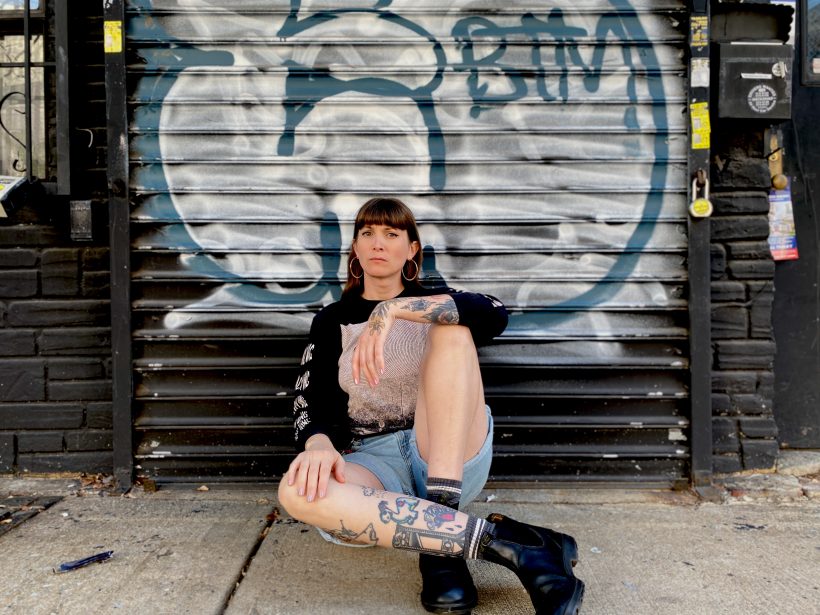
Forest Brienne Cutrer is not widely known in the metal community. She is nonetheless doing some of the most confrontational boundary-pushing black metal music today. While most black metal can be sadly conservative and traffic in 1995 tropes, Cutrer is way beyond church arson and pagan fears. Her music instead tackles topics that make boomer-adjacent metalheads highly uncomfortable: gender identity and fluidity, proudly leftist politics, and music that hints at compassion and change. In that sense, it is truer to black metal’s countercultural spirit than much of today’s music.
Cutrer’s music with Bury Them and Keep Quiet, including the recent collection of remixes Corpsepaint Glamourshots, is unabashedly confrontational but isn’t dogmatic. Like the best confessional black metal, her music is instead an autobiography and a way of confronting her own dark moments, bad decisions, and feelings of alienation.
Cutrer is redefining bedroom black metal for the early 21st century. What was once the purview of angry white incels is being retrofitted for a new generation. She talked to us about her work, her journey as a trans metal musician, and the idea that we should still be kind even if nothing matters.
When I think about early bedroom black metal, I think of the prototypical incel. You are doing bedroom black metal, and you’ve completely retrofitted the music into something else.
I joke and say that I’m a huge poser. I didn’t get into black metal until well after all that stuff had died down. I started seeing people doing more leftist stuff, like the anti-fascist stuff, in 2015 or 2016. That’s when I started listening to black metal. I started listening more and learning more, realizing that there are actually normal, non-shitty people who make this kind of music.
A lot of my music has been either tongue-in-cheek or political as a way to hide from my real feelings, because I’m afraid of putting it out there and being judged for showing real emotions. So I gravitated towards political stuff and silly things. I was in a couple of grindcore bands in college. I am rooted in grindcore and death metal.
Then I got really into a lot of the very obvious leftist black metal, like radical anarchist black metal stuff. I wasn’t an incel; I was just in my 30s and fed up. I felt impotent—like there was no way to get this anger out. I wanted to join the choir of people saying how fucked up everything was at the time, and I didn’t really have a good avenue for that because I wasn’t very social. I spent most of my time running, riding my bike, or working.
So I was like, “Okay, I want to start making music again.” I jumped in at a time when this sort of stuff was coming up and popped onto my radar, and I fell in love with it and found ways to be expressive through it. From my perspective, that whole incel, loser, bedroom-edgelord kind of person was always a loser—someone to laugh at, never someone to take seriously. They were always douchebags, you know?
When you fell in love with black metal, did you then go back and listen to a lot of the OG stuff and study it? What spoke to you?
I almost went in reverse. The first artist I heard was Oathbreaker – a hardcore band that made a sort of black metal album. I was like, “Oh, this is kind of cool.” Then I listened to Deafheaven and Belphegor. I realized that in high school, I listened to Dimmu Borgir and never realized that it was black metal! I was just like, “Oh, this is just like crazy cool shit.” So then I started going back more and more. I had a lot of the blackgaze stuff, then I went back to the bands that influenced blackgaze, and eventually got to the late 90s/early aughts with Cradle of Filth and all that stuff.
I have pretty bad ADHD, though I am medicated for it. When I get on these jags, they take on a life of their own, and I can’t help but dig as deep as possible. So I got to the point now where I’m like, okay, I get it. All the second wave stuff is legit. Growing up, I was a grindcore kid. I’m 40, so I was 15 in 2000—prime target demographic for nu-metal. I actually loved early Slipknot; I thought they were super powerful, and I think that Ross Robinson’s production did a lot of good for extreme music. Having started with something very simple helped me expand.
I understand you recently had intense surgery?
I’m trans. I had bottom surgery. So I’ve got like 12 weeks off of work, with about five weeks before I go back. I can’t lift anything more than 10 pounds, and I’m tired all the time. Physical therapy is a huge part of the day. I’m taking the opportunity to have a forced vacation.
Was dealing with your gender identity a struggle earlier in life?
I grew up in Phoenix and went to college in a suburb at Arizona State University. Moving out of my parents’ house was rough. I didn’t get along with my parents back then—they were abusive, though they’re older and more chill now. I had a weird relationship with sexuality because it felt suffocating and just didn’t feel right. In college, I was very promiscuous because for the first time I realized people found me attractive. I started as an art major, walking around in thrift store clothes, women’s jeans, tight t-shirts, and the swoopy MySpace hair. I started seeking validation from other people—feeling like I was only worth something if someone wanted to sleep with me. I was drinking and partying a lot.
When I was 21, I quit drinking for a few years. I hunkered down with school and got a degree in political science. I would cry at night because that’s when I started thinking, “I’m not a woman… I’m a man, but this doesn’t feel right. Something feels wrong, and I wish I could just magically transform.”
There were no trans people around me. I had one gay friend who was older and very macho, not your stereotypical gay culture guy, so I wasn’t exposed to a lot of queer culture. People nowadays talk about it like it’s a contagion where if you’re around trans people you’ll catch it—well, I fucking caught it without being around any of them. I knew something was wrong inside me. I didn’t know what hormones were; I barely understood surgeries. I was just an idiot 20-year-old pushing it down.
I wrote a few songs about my sexuality in a noise-rock solo act while presenting as a straight cis man, just treating it like a joke or a social experiment. Then I moved to New York City after graduating, came out to my friends as bisexual, and had this long, meandering journey. Every few years I’d have a revelation, feel overwhelmed by how limiting the physical world is. By my late 20s, I decided I was just going to carry it to the grave and never admit it outright to anyone until I died.
What broke that?
COVID. I was turning 35 and realized I was always thinking about my own death and how I could never imagine being an older man. I couldn’t picture the future. I thought, “I’m going to be 35 in a month or two. I don’t know if I have another 35 years left, and it would be a big shame if I lived over half of my time on Earth living a lie out of fear.”
I was terrified, but I came out to my wife in 2021—she’s still my best friend—and she encouraged me to do something. About three weeks later, I was on hormones and getting my beard lasered off. I used to have a big old beard and long hair, hiding everything from everyone. There are still pictures floating around from my first Bury Them and Keep Quiet album where I’m in my old ways, and it’s funny thinking, “He thought he had everyone fooled.”
Was Bury Them and Keep Quiet one of the ways you were able to cope and step into the identity you always wanted? Was it part of figuring out how to tell your story?
Kind of. I also have a project called Ocean of Ghosts, which I started back in 2007, and that was initially my way of coping with rumination and fixation on death. Bury Them and Keep Quiet was a way to reinvigorate that fire. It forced me to get my chops better on guitar, care less about experimental stuff, and focus on mixing and writing faster, angrier music.
My first release was pretty political. It was 2016; I hated Trump, I hated what America was becoming, so I wrote about it. Once I decided to transition, I definitely marketed myself as a “trans black metal musician.” I connected with other trans women making similar music and found out there’s a bunch of us putting a new twist on a decades-old style. Metal was always where you hide things, bury your emotions, light stuff on fire, and flip over a car—this was a way to keep that same energy and momentum and put a more feminine spin on it without making it softer. It was a way to reclaim femininity.
Eventually, I pulled back from marketing myself that way. In real life, being trans isn’t the most interesting thing about me. I live with my girlfriend, I’m a service manager at a very busy high-end bike shop in New York City that I’ve worked at for 20 years, and I’m just a normal 40-year-old white chick living in New York. I try to lean into the trans marketing less now because I don’t want the heat from the publicity that comes with it.
You keep using the word “reclaim,” but if I look at the roots of this music, it’s based in “no values, fuck everything, destroy the world.” Isn’t “reinvent” a better word than “reclaim?”
That is a good argument! I agree with you halfway. My take on this particular kind of music is yes: no values, nothing matters, fuck everything. But I don’t think the next statement should then be “burn it all, hate everyone.”
To me, it’s: “Hey, none of this matters, we’re all going to die, money isn’t real, and Christian right-wing morals are made up and oppressive. So let’s just have fun while we’re here and be kind to each other.” I struggle to believe that people, when left in a vacuum, are inherently evil.
Those second-wave kids who started this music were suburban edgelords who wanted to piss people off because they were mad at their dads. None of them were poor; they were just angry 20-year-old white men. I would challenge the impulse to jump from “nothing matters” to “everything sucks, let’s burn it all,” and instead change it to: “Nothing matters, so everything’s kind of cool as a result. We’re not beholden to anything but ourselves.”
Songcraft is important to you. You keep songs short, with great hooks and an industrial flavor. Were all those things intentional?
Yes. If I’m listening to a song that’s 10 or 15 minutes long, it’s got to be fucking good—like Black Sabbath or really good doom metal. Bands like False did long black metal songs well, but I’m not that good, so I stay away from that. I grew up on pop music, so I like hooks. That’s what I loved about nu-metal and metalcore like Dillinger Escape Plan and Converge—each song has a specific thing to grab onto. When there isn’t a hook in a song, my brain gets sad because I want something to follow.
Most Bury Them and Keep Quiet songs start from a guitar melody. I also try to keep things in the same scale and key because changing scales mid-song throws me off as a listener. The singer of my local band always says, “We got to have something to hang your hat on,” and that’s how I write. Simple is hard. I love Bolt Thrower and Asphyx because they’re simple, effective, and done with 100% intent.
As for the industrial elements, that came from not having good equipment. I used a Zoom MRT3 drum machine that I bought in high school for $90 for decades. I learned how to program that thing with my eyes closed. It sounded like a bad Godflesh drum machine that only sounded good when turned up all the way. Now I use Logic Pro and program MIDI drums, but I’m still trying to capture that feel of an analog drum machine. My song structures are usually standard pop structures or loud-quiet-loud post-rock dynamics.
Do you see yourself playing out live or getting musicians to bring this to life? Or do you want to keep it where it is?
For Bury Them and Keep Quiet, that’s not a goal of mine. For my doom project, Ocean of Ghosts, yeah—I’ve done live shows with that and it’s fun. With Bury Them and Keep Quiet, I would have to change the way I write songs. I’m currently the bassist in another bedroom metal band where the singer brought in live members, and noticed how much his original vision had to change. Most of my stuff would require three or four guitarists to replicate live, and teaching people the songs would limit my creativity.
When did you decide to make the full surgical transition, and what was that process like?
When I first started transitioning, I thought, “No surgeries, it’s too much.” Then I realized I was just afraid to admit what I wanted. First I had facial feminization surgery, and then around 2024, I decided to do bottom surgery.
There are so many hoops you have to jump through in America: finding the right insurance, getting proper FMLA time off, a year-long wait just for a consultation, and then 17 or 18 months from consultation to the surgery date. You need multiple letters from mental health professionals and physicians stating you’re of sound mind, healthy, and have proper caretaking support. It’s crazy that you need an army of people telling doctors it’s okay for you to make decisions about your own body. I try to count my blessings that insurance covered most of it beyond my out-of-pocket max.
It’s a very long process, and managing doctor appointments with ADHD is tough. I had to take 12 weeks off work, and my girlfriend has been taking care of me. Physically, it’s awful. I’ve ridden my bike across the country from the Pacific to the Atlantic by myself, run ultramarathons, and done mountaineering, but this surgery is one of the hardest things I’ve ever had to do. I’m seven weeks out now, and the feeling of being kicked in the crotch by a football team is finally receding, though it takes about a year to fully feel normal again.
Do you think black metal is being retro-engineered away from isolation and darkness towards community and hope? Is that accurate?
I don’t know if I agree with the premise that it started purely from isolation—I think people made it about that out of geographic necessity and ran with it. I’m not single-handedly pushing it towards community; that’s just the natural evolution of it because the music is made by and for outcasts. Now that we have the internet, those outcasts connect worldwide. Personally, my brand is “positive nihilism.” More people are just fed up with being pissed off all the time and getting nothing done.