If you’re of the generation that read RIP magazine and scoured album credits for clues about your favorite band’s favorite bands, their collaborators, and the folks behind the scenes, you already know who Del James is. If not? Here’s the short version: He was an editor at RIP who also happened to write some lyrics for Guns N’ Roses’ Use Your Illusion albums—and pen the short story that inspired their “November Rain” video. (That story later appeared in his 1995 collection The Language of Fear with an introduction by Axl Rose.)
These days, James is still tight with G N’ R: So tight, in fact, that he’s been their road manager since forever. Meanwhile, he’s been writing lyrics with Chuck Billy of Testament since 1992’s The Ritual. He contributed to four tracks on the band’s latest, Para Bellum, including the song “Room 117,” about the recent passing of James’ mother.
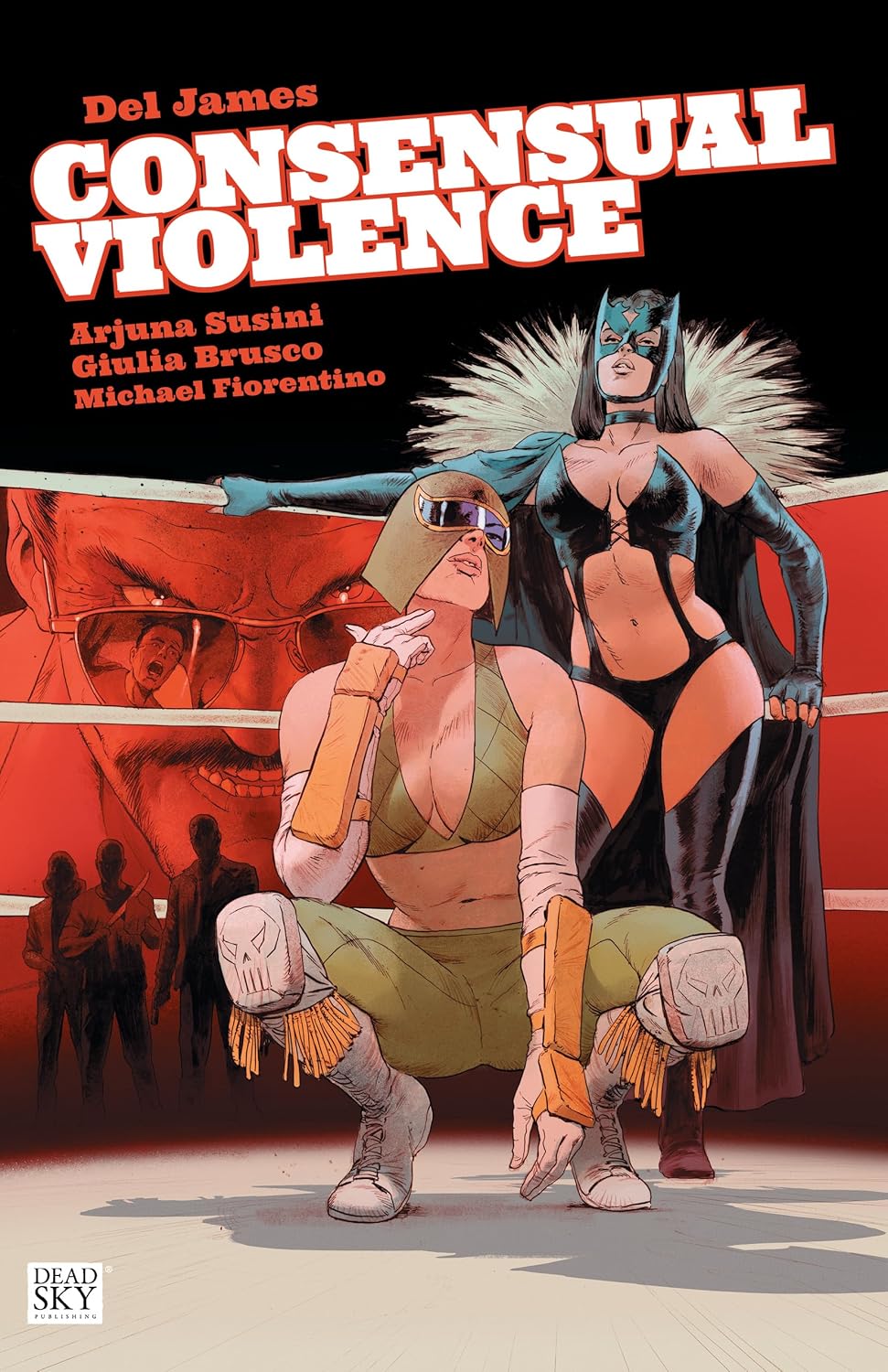
He’s also a massive wrestling fan and comics enthusiast. Our man recently combined these two passions in Consensual Violence (released via Dead Sky Publishing), a tale about a badass luchadora out for revenge who gets tangled up with ruthless narcos in Mexico. Featuring a taut storyline and action-packed artwork by Italian illustrators Giulia Brusco and Arjuna Susini, Consensual Violence delivers bloodshed both inside and outside the ring. Below, James gives us the rundown.
Tell us a little bit about the inspiration for Consensual Violence. It started as a movie script, right?
The inspiration for Consensual Violence came from watching an El Santo and Blue Demon movie. I don’t remember which one it was, but I was struck by the awesomeness of dudes driving around in convertibles in masks and capes and walking into a bar, all casual, like, “Nothing to see here.” And then I started thinking: How do you make that into something more realistic, something more believable? And that’s where the initial kernels of Consensual Violence started. I wanted to have superheroes without superpowers in a fucked-up situation and somehow make it make more sense than Batman or El Santo. So that was the motivation, so to speak.
How did you decide on the title?
Somewhere, I read the term “consensual violence” applied to professional wrestling. Which makes sense: You’re trusting the other person you’re working with not to hit you too hard, but not to hit you too soft so it looks fake. It may have come out of this book about the original Sheik from Detroit, not the Iron Sheik, and that author was Brian Solomon. I think that may be where I saw it.
Why was it important for you to make the main character female?
Again, it goes back to the wearing of masks. Here’s an aspiring wrestler named Krysten Moore, who has a horrible thing happen to her and she’s disfigured. So, what’s she going to do? She’s going to put a mask on and continue to wrestle. And there was a wrestler from Japan named El Samurai who had those eye shields like Krysten’s mask has, and that was done on purpose to shield her injury and keep it so you can’t see her eye patch. Towards the end, she becomes more liberated from the harm that was done to her. She’s out to exact revenge, don’t get me wrong, but towards the end she’s more comfortable in her own skin. That’s part of her process, part of her growth.
You could have easily set the story in Los Angeles, where you’ve lived for decades. Lucha Libre is alive and well in L.A., and certainly the cartel operates there. Why’d you want to set it in Juarez, Mexico?
Because Mexico is the heartbeat of Luche Libre. It started there. It’s part of their culture. And if you’ve ever been to El Paso, you can see Juarez right there. You can cross the bridge and take your life into your own hands. So, it’s a perfect setting for a lucha- centric, very Latino-flavored graphic novel.
You’ve been a wrestling fan since you were a kid. Do you have a theory about why you stuck with it for so long?
There have been moments when I did not give a fuck about professional wrestling. There were moments where the product being put out didn’t interest me. There were moments where I was obsessing with something else, whether it was music or film or whatever, but there’s also times where you’re really caught up in wrestling.
In the ’70s, when I was a kid staying up ‘til midnight to watch wrestling on WWOR television, channel nine, it was quite an accomplishment. There were these larger-than-life villains talking shit in their interviews. It’s very seductive, especially to young kids. Then you discover Led Zeppelin and Judas Priest, and other things that take precedence. But then something will happen, whether it’s Saturday Night’s Main Event or the WWFs zeitgeist of Hulk Hogan and Hulkamania, and you tune back in. Then it fades away again once it becomes too cartoony. And I remember… do you know Pat Hoed?
From Brujeria?
Yeah, and he was Scarface the Womanizer in a punk rock band called Foreign Object. Pat and I are good friends, and we used to go to wrestling here in Los Angeles to see Chavo Guerrero and Roddy Piper, just these fantastic cards. We always spoke the language of wrestling, and he turned me on to two VHS tapes of ECW wrestling. That was all I needed to light the fuse again. The shit was so adult, so violent, so extreme. This was in the days where you had to buy a [satellite] dish to see all this stuff, so that’s what I did. And then we’d go to WWF shows here in L.A., and you’d see Zakk Wylde there. You’d see Kerry King. There were moments when the shit was undeniably hot.
Back in September, you and I hung out at a Circle 6 event in Hollywood that a mutual friend of ours performed at. I’d never been to one of those before, and I thought it was insane. There’s no ring. The wrestlers are beating the fuck out of each other right in the bar, smashing tables and shit. What’s your take on that style of wrestling?
There’s almost like this punk rock thing going on in the independent wrestling scene right now with the death matches, the no-ring bar fights, all of that. It’s exciting, it’s fun, it’s festive, it’s interactive. If you don’t move out of the way, you’re going to get to run the fuck over. Circle 6 is a lot of fun. There’s something for everyone. They crosspollinate with a band performing and then wrestlers performing, maybe even some dancers and then some more ultra violence. That’s a perfect evening.