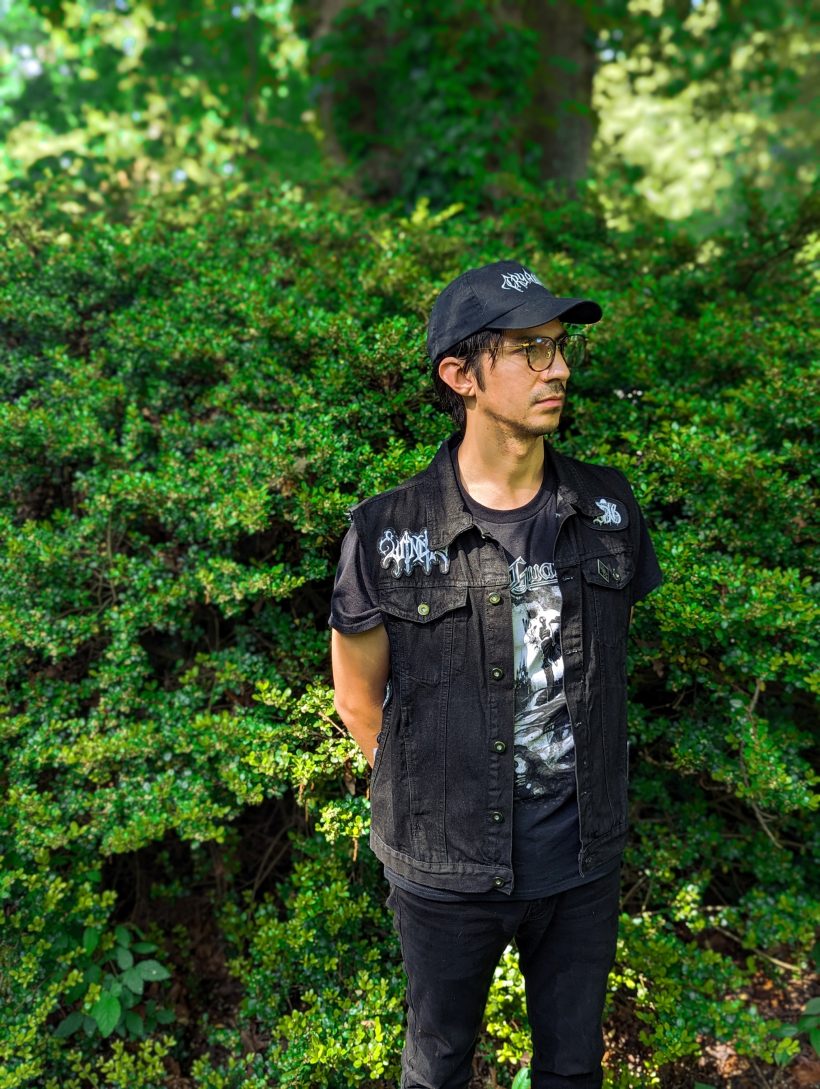
One week from today, Americans will get together with family and friends to celebrate Thanksgiving (apparently, it’s the only day they will stay off the Internet, too, since I was told no one would read this the day before the holiday). While looking for something to write about that could tie in with the most underrated holiday, I stumbled across the American black metal band Lammoth.
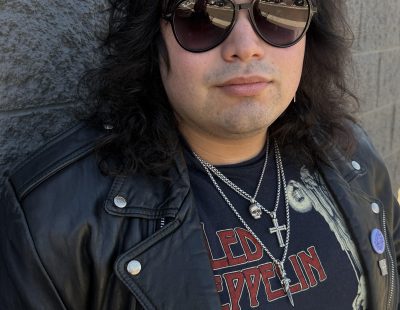
Now, many bands have looked to author J.R.R. Tolkien for inspiration, dating back to Led Zeppelin’s “Ramble On.” But Lammoth, a one-person band fronted by Rob Sanford, takes it a step further: the entire musical output is Hobbit-themed. Hobbits love feasting and merriment and celebrate something like Thanksgiving every week, so we decided to learn more. Sanford told us about his project and his love of Tolkien—happy early Thanksgiving to all of you.
What was the genesis of the project?
Rob Sanford: It started around the tail end of the pandemic. I had some history with black metal, but not much. I moved in a post-rock direction in the late 2010s, then got bored. I started falling in love with black metal again, seeing what was happening with modern atmospheric black metal and stuff that seemed to be breaking into niche subgenres I hadn’t noticed before. That’s what inspired me to start a black metal project, and then it was about figuring out what I wanted it to look like.
Looking at my personal tastes in music and my philosophy, it didn’t feel right to do a meat-and-potatoes black metal project. Obviously, there’s the Tolkien connection that’s historically run through the blood of black metal since the ’90s. I tried to think of fresh ways to combine Tolkien and black metal, using genres that hadn’t been explored.
I think some black metal artists who were into Tolkien didn’t realize there were actually bad guys and good guys in those books.
Sanford: (laughs). For sure, the emphasis seemed to be on the bad guys. Of course, they look cool or are described as super cool in the books. But at the same time, the Hobbits were the core of The Lord of the Rings and The Hobbit, the bulk of the Middle-earth Tolkien legendarium. So I thought it was interesting thinking about how listening to black metal, sometimes you feel comfortable when you’re listening to it. It’s not like you’re sitting there saying, “I hate this.” You’re saying, “I love this,” and that’s a comfortable thing. Combining that idea with hobbits maximizing their comfort—that all clicked for me. And I was like, “Whoa, this seems like it’s a good idea.”
You’re a multi-instrumentalist, correct? How did you learn how to play so many different things?
Sanford: I’ve been doing it most of my life. Drums were the first thing I ever attempted to learn. I think I was seven or eight years old when I first started. A couple of years later, I convinced my parents to trade the drum kit for a guitar, and I picked that up and made it my main focus for several years. And playing in bands, you always do the thing when you’re jamming in the garage where one guy says, “Hey, let me hop on the drum kit, and you hop on this,” you shift around and goof off for a little bit. So, growing up in bands, you get exposed to other instruments, and you pick up tips and tricks from your fellow bandmates and musicians. Experimenting and trying different things throughout my whole life is where I got most of my experience.
Athenar from Midnight has talked about how he did just enough to get okay on a bunch of instruments, then moved on. Was that your experience?
Sanford: To a degree, for sure. I got obsessive about the guitar for a long time, but never quite to the same level. I would never consider myself an advanced shredmaster guitarist. I definitely relate to learning just enough to get by and communicate the ideas you’re trying to get across.
I can think of a lot of shred masters who haven’t written songs I love nearly as much as people who are just competent at the instrument.
Sanford: That’s something I think about a lot. In the early days of music, even going back to classical, there was a much greater emphasis on virtuosity. I think now, with the sheer volume of music out there, the flash and excitement of someone being insanely good at their instrument has faded. People aren’t as impressed watching a technical guitar solo as they were 15 years ago. Now, you can see some eight-year-old kid on Instagram doing it insanely well. It’s just saturation. At the end of the day, what I care about most is good songwriting and music that makes me feel good and sounds good.
The Ramones gifted us that. Right in the middle of the bloated prog era, they came in, doubled down on basic rock and roll, and wrote some of the best songs of our lifetime.
Sanford: They brought back the idea that you could still write songs and not have to be showy. Obviously, there’s a theatrical side of punk that happens on the side, but The Ramones definitely combined that idea with really good songwriting and poppy song structures. It was a good call.
When you decided to go in this direction, how did you write black metal while staying honest to your love of songcraft? A lot of black metal, frankly, does get far out there on the virtuosity side.
Sanford: I don’t know if I’ve really consciously thought about it. I lean into that atmosphere and focus on riffs or pieces of music that make me feel a certain way, not necessarily on the mechanics of what’s going on with the instrument. Definitely a lot of trial and error, too. You don’t hear all the tidbits and riffs I’ve recorded over the years that will never see the light of day.
How much of a Tolkien obsessive are you? Has this been something that’s coursed through your whole lifetime?
Sanford: I was exposed to The Hobbit first, when my dad showed me the book when I was super young —probably four or five years old—two or three years before the movies started coming out, I think. It was one of those things I instantly gravitated toward. And then once I found out about The Lord of the Rings, the obsession just grew deeper and deeper, and it stuck with me my whole life. I’d definitely consider myself Tolkien-obsessed, but I don’t go as deep as the Tolkien professors and scholars. There are definitely people who know more than I do, but maybe the love and passion are about the same.
So you’re not one of the people who learned Elvish, like some people learned Klingon.
Sanford: Correct. As cool as that would be, I don’t know if I have the patience to do something like that.
The first part of me thinks, “That’s really cool.” And the other side of me is like, “What a time investment for something that you basically can’t do with anyone else.”
Sanford: That is a valid point. Being able to share your knowledge, or practice it with other people, motivates you to learn new skills.
What is your process for tying stories together, writing narratives—how do you mix that with the black metal that you’re writing?
Sanford: Nine times out of 10, the musical idea comes first, and then I look through the stories or characters or things like that and try to pick something that fits the vibe of the piece of music. Sometimes—I don’t have that much music released, but with what I have released—some of it is made up. So there’s almost a fan-fiction aspect to it: I’ve made some music that doesn’t quite fit anything from the text, then I read between the lines and craft something that makes sense, at least to me and how I view Tolkien.
Black metal folks are notorious gatekeepers. Have people thrown any shade at what you’re doing, or is it such a niche that you’ve only found other people who love the same stuff you do?
Sanford: For the most part, it’s people who love and appreciate the same stuff. With the exposure Onward has gotten, I’ve seen comments on YouTube or Reddit from some guy who’s like, “We’ve strayed too far from God’s path”—comments like that, where people think black metal should sound like it did in 1992.
To me, that comment screams success.
Sanford: (laughs) Oh, I appreciate it. I think of it the same way. If you’re not getting any hate, then maybe you’re not pushing hard enough. Not that you need to push boundaries at all, but…
Some of these artists talk about pushing boundaries and turn around and do and say the same things that have been out there for three decades.
Sanford: It’s so true. There is a bit of a dichotomy there: black metal started as a counterculture—the whole point was to go against the grain. But at the same time, everybody wants to act, look, and sound the same. So those two ideas seem to contradict each other.
Tolkien’s lore and his universe are so rich. The hobbits usually drive the narrative of these stories, but what did you find most fascinating about them, story-wise, when creating your musical universe?
Sanford: The Hobbits are in their own bubble. They’re not really connected to the bigger schemes and events happening across the whole continent of Middle-earth. They’re just doing their own thing, minding their business. You see that too when Bilbo goes off on his adventure and comes back—everybody looks at him as an oddball. Hobbits weren’t known for going on adventures or doing anything like that. But then The Lord of the Rings happens, and four hobbits go and change the entire course of this world’s history. I find that so interesting—this duality where you’ve got these creatures who are just hyperfixated on comfort and minding their own business, but then, at the same time, you’ve got characters like Frodo and Sam, Merry, Pippin, and Bilbo who go off and do these incredible, selfless things.
In Star Wars, Luke was just a kid working on a moisture farm, not part of the larger events happening around him. He gets thrust into this much larger universe and becomes a main player. It’s a common narrative arc in fantasy and science fiction.
Sanford: It says a lot about someone’s character when they have to act under pressure and make major decisions with very limited resources, knowledge, or experience. And I think the hobbits in The Lord of the Rings portray that really well. Just the things they do, the way they react to everything, it seems so selfless and wholesome and hopeful, and that’s something I get really inspired by.
How do you balance in your songwriting the stories about the quest side of the hobbits versus their very strong domestic tendencies?
Sanford: I think the natural sound of black metal tends to lean more into the quest side of things. Black metal has that element of danger and threats that comes with going on a quest or adventure. You don’t think about being blasted by drums and walls of guitars while you’re just sitting at home, relaxing—at least the average person doesn’t, right? It just depends on the vibe of the music. I definitely have moments in some of my songs that feel a little more uplifting or comforting, leaning more into being a domestic hobbit.
Are people finding the band through the Tolkien connection, or because they’re looking for off-center black metal?
Sanford: It’s a little bit of both. I’ve definitely got a lot of comments from people that aren’t even black metal fans at all. Maybe they were Tolkien fans and they just liked the idea, so they checked it out and ended up liking it. There are definitely a lot of black metal fans who are bored or just tired of the same old thing played over and over again and are looking for something fresh.
Have any Tolkien obsessives called you out for getting anything wrong?
Sanford: (laughs). Oh man, I feel like there was something. I’m trying to look back, but I don’t think anything super specific. I feel like I do a pretty good job. When I’m writing lyrics and stuff, I keep the books open and flip through the chapters to pull ideas.
Are you worried that you might run out of Hobbit stories and have to switch to the Ents?
Sanford: It is definitely a subconscious fear I’ve had in the back of my mind, but every time I think about it, I’m just like, “Well, I’ll cross that bridge when I get there.” I think I’ve got enough material lined up to keep me going, and if I ever run out, then I’ll figure something out in the moment. But for now, I don’t see that happening.
What does a Hobbit-themed black metal artist do for Thanksgiving?
Sanford: It varies year to year—Thanksgiving’s kind of a weird holiday. Some traditions are tied to some not-so-great parts about European colonialism and indigenous folks. At the same time, I think Thanksgiving has become something else where it’s just an excuse for families to get together and reflect on the things they’re thankful for, which obviously I appreciate and think is great. Nowadays, it usually ends up being just my wife and me staying home. We’ll cook maybe something special, but we don’t go super crazy making 10 different sides just for the two of us.
If the Hobbits had an equivalent of Thanksgiving, what might they do?
Sanford: They would probably get together as a whole town, like we see Bilbo’s birthday portrayed in the first movie. I imagine something like that: everybody gets together for a massive Shire potluck; everyone brings something, and they have a big old merry feast and party.