
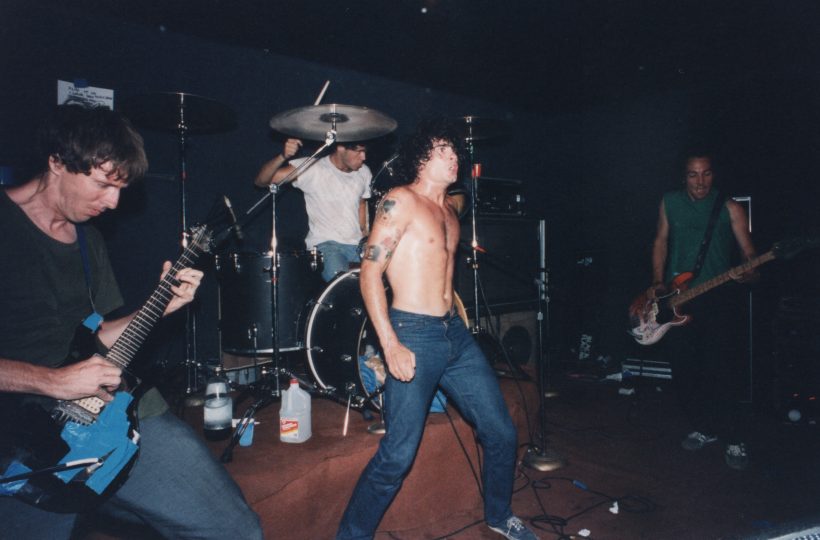

Right now, septuagenarian Greg Ginn might be setting up a “Black Flag” show with his 30th Gen Z lineup. Granted, the guy is a genius and wrote much of the music, but Black Flag circa 2026 is beyond weird and, sadly, unbefitting of the legacy of one of the heaviest, most volatile bands ever to walk the earth.
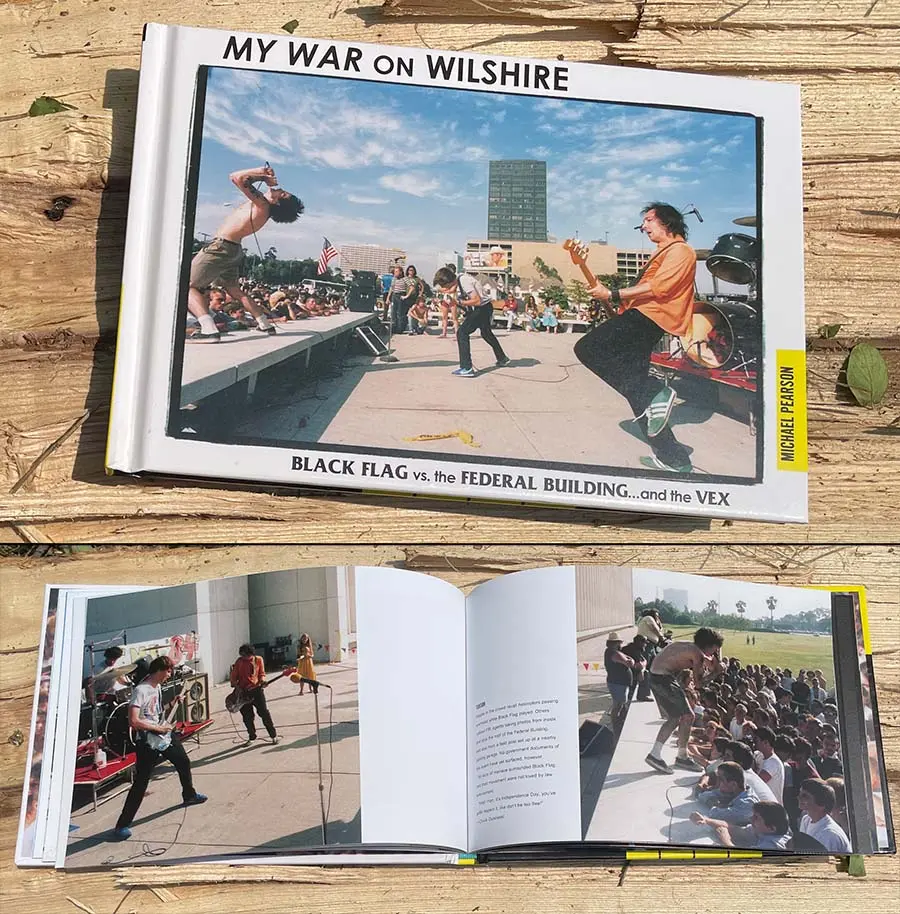
If you’d like an up-close look at a time when Black Flag was the most untouchable band on the planet and want to know why people still care, check out the new Bazillion Points book My War On Wilshire: Black Flag vs. the Wilshire Federal Building…and the Vex. The photos – many of them never seen – document peak Black Flag as well as several supporting bands. Photographer Michael Pearson talked to us about shooting those legendary shows.
How did this project come together?
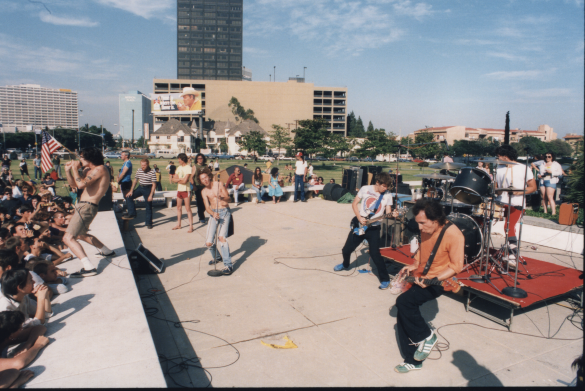
As a kid, I took a lot of photos. I had an Olympus OM-1 35mm. I would shoot skateboarding, surfing, my friends doing things, riding motorcycles on people’s lawns, just stupid stuff. But I didn’t bring my camera to punk shows because I wanted freedom—I didn’t want to lug it around or risk breaking it. When I was 18—after I’d been into punk for two or three years—I was super into Black Flag. I thought that daytime show at the Federal Building wouldn’t be so outrageous that I couldn’t bring my camera easily. I had fun doing that, and it came out good, so I went back a couple of weeks later and took shots of Black Flag at the Vex.
What made you decide to finally put all this stuff together? Were your archives in good shape?
My photos were in this IKEA cabinet that I’ve had for years. I was going through stuff, saw the Black Flag photos, and said, “Wow, these are pretty good, actually. Maybe I could get this turned into a book.” I was thinking of doing it myself—putting Black Flag at the Federal Building on one side and Black Flag at the Vex on the other, like one of those flip-over books they used to have. Then I could get someone to publish it so I could get it out to more people. I looked online and saw that Ian (Christe) was doing Bazillion Points. He’s got all these punk books and metal books. I emailed him, sent him the pictures, and he said, “Yeah, I think maybe we could do something with this.”
I look back now and see all these great photos by Edward Colver and different people, and I’m like, “Oh my God, if only I had just decided to bring it and shoot.” But I was so into just slamming, running around, watching from the front, and being free.
You mentioned skateboarding, but what about punk rock at the time spoke to you?
I grew up in the late ’70s. We were really on our own—our parents didn’t supervise us. They thought, “You’ll be okay; whatever you’re doing is probably fine, we don’t have to worry about you.” But they should have worried about us! We were on our own, and part of that brings loneliness, bitterness, anger, frustration, and sadness. When punk came out, I related to the angry, bitter, disenchanted part of it. I also just loved the action—how fun and dynamic it was. You could be a part of it at a show, instead of going to a big rock show where you’re sitting far away just watching. You feel like you’re just as much a part of it as the band.
How strong of a photographer did you think you were, and how were you able to capture these moments?
I already had some camera skills from taking a lot of shots. I’d photographed my friends skateboarding, so I had to have timing skills to get the person with the board at the right angle. You had to have focus skills—back then, you had to focus it yourself while shooting. You didn’t have a constant stream like video; you had to take single shots. I was already pretty decent with the camera. When I got excited about the Black Flag shows, I brought my camera and had the nerve to go up on stage and sit in a good spot. It just worked out really well.
Later, I thought I could have been at all those crazy shows. I got into punk rock pretty early on, before it became super popular, so I could have gotten some crazy shots back in the day. But I didn’t want the responsibility of having a camera. Shows were so wild that I figured I’d get my nose broken or my camera smashed into my face, so I didn’t bring it.
One thing I love about these photos is that they capture so many details of this moment in time in the early ’80s.
You really can see Westwood before—it looks completely different now. If you go to the Federal Building, instead of a grass lawn, they put plants everywhere, and there’s a wall around it because of 9/11. If you look in the background, there’s a house that’s not a house anymore; it’s a giant skyscraper. And you’ve got the Marlboro Man—they don’t have the Marlboro Man anymore. I got all these different shots, and I’m glad I shot the crowd because I can see a lot of people I know and some semi-famous people in there. It’s cool.
Did you interact with the band at all on those days, or did you stay to the side taking pictures?
I never talked to them. I was too shy and scared. They were heroes to me. If I had a conversation with them, my voice would crack, and I wouldn’t even be able to talk, so I didn’t even think about it.
What state were the photos in, sitting in that IKEA cabinet, and how did you or Ian get them pristine enough to get published ultimately?
They were in great condition. I never even touched them; if I showed them to people, I held them up myself so they wouldn’t get fingerprints. I scanned them on my cheap Hewlett-Packard scanner at the highest resolution and sent them all to Ian. I think he did a little dust removal, but they were ready to go. The composition was pretty good from how I framed it in the camera—we didn’t have to do any weird cropping.
Back in the early ’80s, I was super into all this stuff, and I guess there were two or three thousand kids who were into it. Then hardcore went out of style, and it was kind of gone. It was almost like what happened to skateboarding—skateboarding turned into street skateboarding, and vertical wasn’t as big in the mid-’80s. I thought nobody would care. Many years later, I realized Black Flag is kind of like a classic rock band or a classic punk rock band—they’d become legendary and seminal. If you’re into hard music, you’ve got to know about Black Flag. Then I dug them out and sent them to Ian.
What was Ian’s reaction when he saw them?
He emailed me right back. It took a while to put it together—a couple of years to get it the way it is—because he’s working on a million other things at the same time.
When someone picks up this book and looks at these photos, what are you hoping they get from seeing these images?
Older people who were into hardcore punk will be taken back to that time—it’ll be almost like time travel, where they go, “Oh my God, Black Flag, look at that.” Younger people might not have a visceral reaction because music you get into as a teenager imprints on your mind and soul so hard that it lasts your whole life. Older people are really going to get a kick out of it. For younger people, it might be more historical, though maybe some kids will put the music on and become fans.
Music you hear as a teenager sounds best to you for the rest of your life.
You’re so fired up at that age, and everything is so new. When you hear something you like—or see the visual, the video, the album cover, the band photos—it gets cemented in your head.