
A lot has changed within Crowhurst since the band, led by frontman Jay Gambit, released their last major project, III, in 2019. Though the band released a few smaller projects in the immediate aftermath, it’s been seven years since Gambit and his ever-changing list of collaborators released a proper full-length. Enter Thorns, a long-gestating project that takes Crowhurst through realms of dark jazz, ambient, psychedelia, drone and extreme metal.
The full lineup features Gambit (samples, sound manipulation, electronics), White Ward’s Dima Dudko (saxophone), Claire Deak (harp, flute), Christian Molenaar (drums, violin), Churchburn/ex-Vital Remains guitarist Dave Suzuki, Justin Sweatt (synth), Isaac Takeuchi (cello, violin), Mark Warm II (piano), prolific producer Jeff Zeigler (vibraphone) and Sleepwalker’s PBV on no less than six instruments. It’s a massive undertaking and a rather large departure from what readers have come to expect from Crowhurst, so Decibel sat down with Gambit to get into the nitty gritty about Thorns: the underlying concept, coordinating 10 musicians recording in different places, songwriting and the importance of making art that calls to you.
Thorns is out on November 6 via Sleeping Giant Glossolalia, with pre-orders coming later.
It’s been seven years since III came out. What, like what’s been the process since then? Have you been working on this new record, Thorns, since then or did you take some time to do other stuff before you came to it?
I started Executioner’s Mask around the time that the pandemic was starting, and I worked on a few of those records for Profound Lore Records and that was pretty fun. I got to work with Gerald Scarfe who did all the art for Pink Floyd’s The Wall, which was fun.
So that band kind of takes off and does its own thing. What does it look like for you when you come back to Crowhurst?
Honestly, I didn’t really feel like it was worth coming back to the project unless I had something significant to say. I’ve been working on Thorns pretty much since before the pandemic. We were supposed to fly to Château d’Hérouville to track that, but the pandemic kind of put the kibosh on it, so we were sort of forced to reevaluate what the record could be. The extra time through the pandemic made it a little bit easier because I feel like everybody sort of had the opportunity to to figure out their recording styles and just give people a little bit of time.
Do you think that the record was the shape of the record that you had in mind originally? Does it sound like that today?
No. Honestly, it sounds significantly bigger now and more involved than I could have imagined it being had we just taken a studio approach because this is so layered and so dense that it really did sort of require everybody who was working on it to take their time and work through their own process to get it done the way it had been done.
Would you consider this to be a significantly different record than others than other records that you’ve done, or do you feel that it’s close to some of the drone work you’ve done in the past?
I think that where Thorns sits is in a place that is informed by pretty much every era of Crowhurst. It has elements that are really harsh. It has elements that are very psychedelic. It’s got elements of classical and traditional classical music. It has elements of minimalism, black metal. There’s a little bit of everything right up until the end of that run with III into the film-scoring work.
It’s probably the most easily-listenable record you’ve made in a long time. Not in that it’s not dense but I think that it feels very polished. It feels like there was an intention of the way that it was supposed to feel and kind of take you through.
I took more influence in this from things like A Silver Mount Zion Orchestra’s He Has Left Us Alone but Shafts of Light Sometimes Grace the Corner of Our Rooms… and Sunn O)))’s Monoliths and Dimensions, the Kronos Quartet film score. Stuff like that was all a much closer touch point for influence for me than a lot of traditional noise and metal stuff, but I think those are things that also stand there, on their own, as being heavy enough for listeners of extreme music while being accessible enough for people who aren’t really informed in that world.
It feels, not to make the most obvious comparison in the world, similar to a band like Ulver that has metal and and harsher roots, but so much of their work after that fits in that realm, even if it’s not explicitly noise or metal.
Perdition City is another one that was an influence in making this, the idea of something being truly cinematic.
We’re talking about how Thorns is cinematic.There’s an underlying concept behind the record, right?
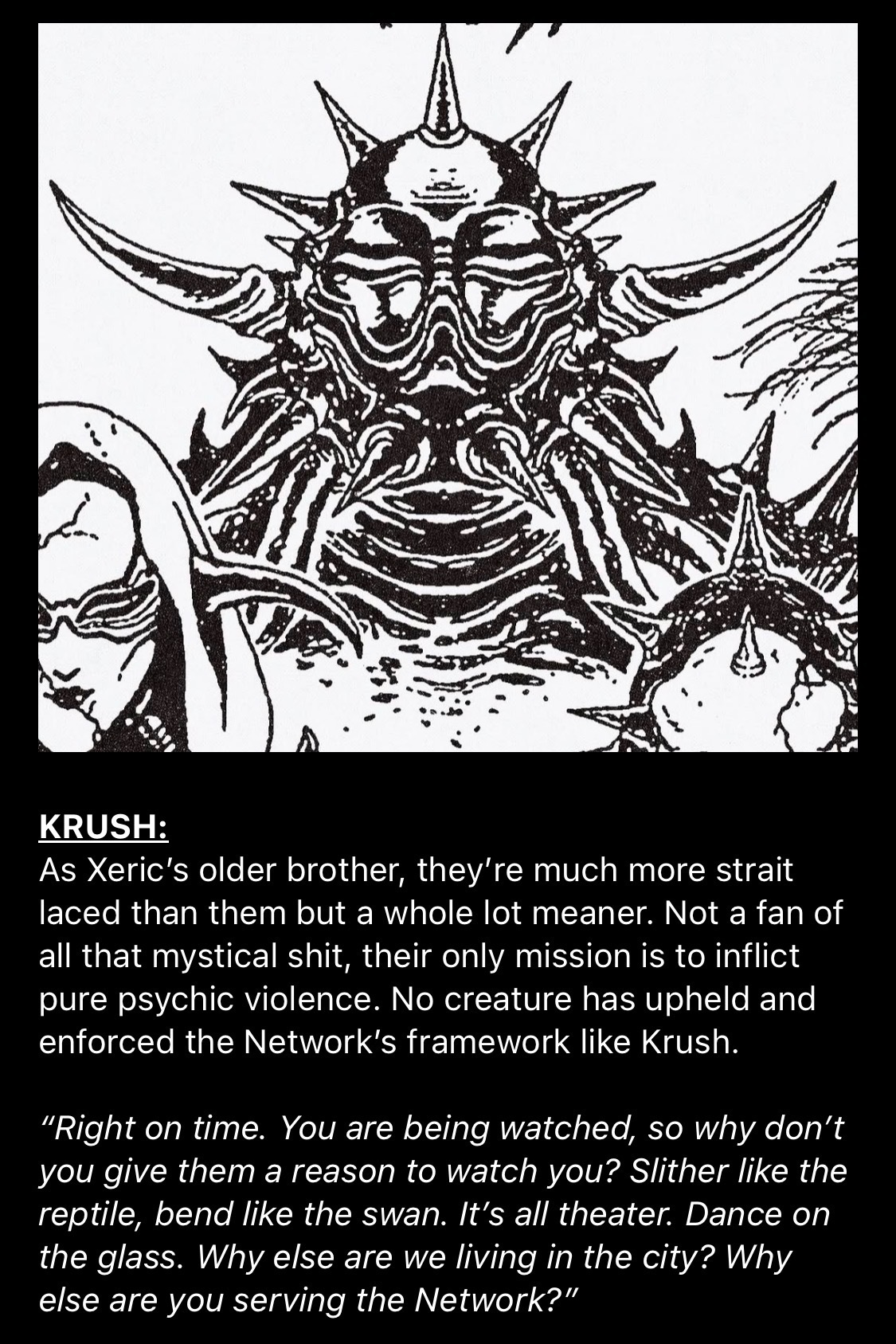
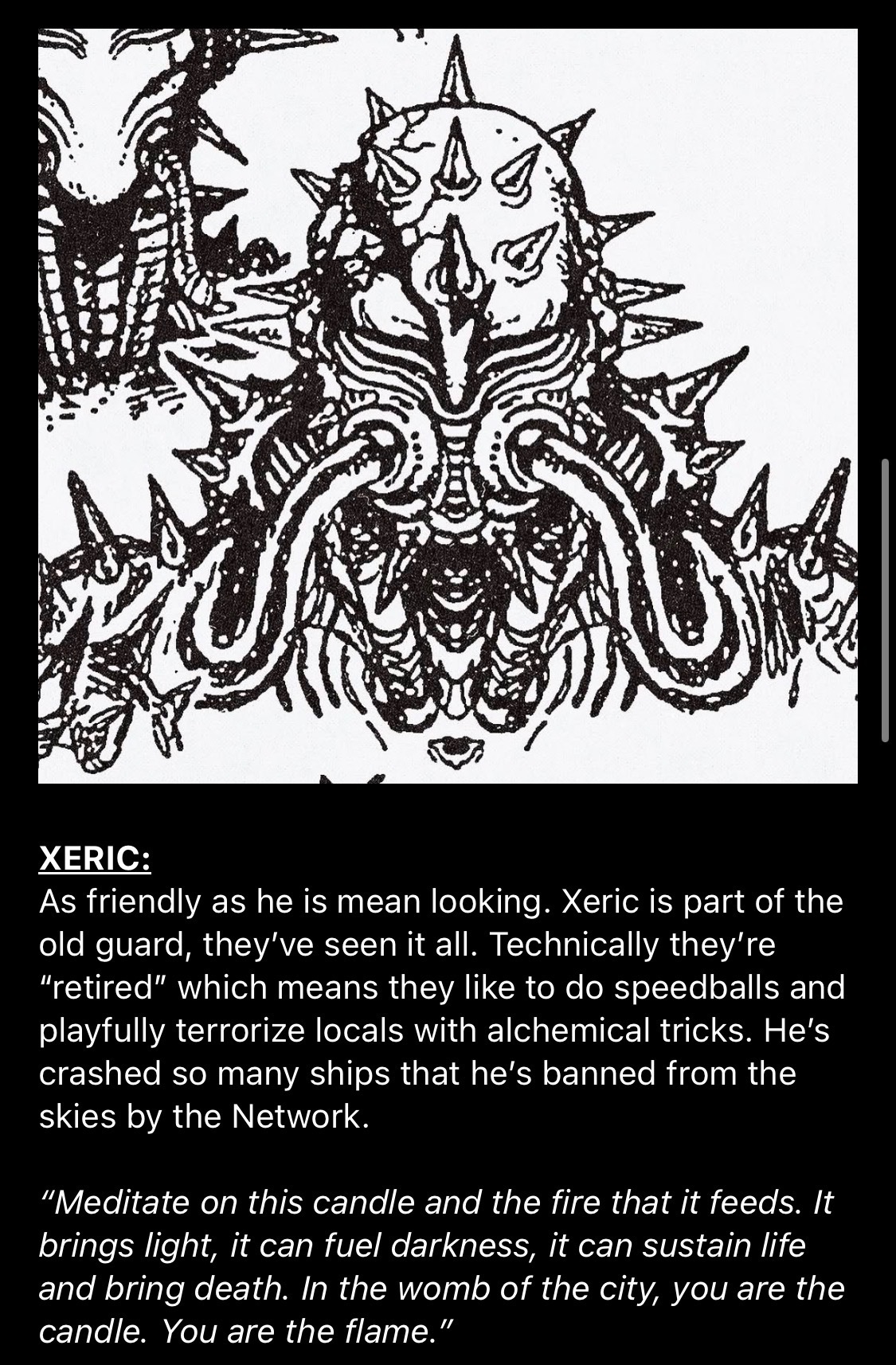
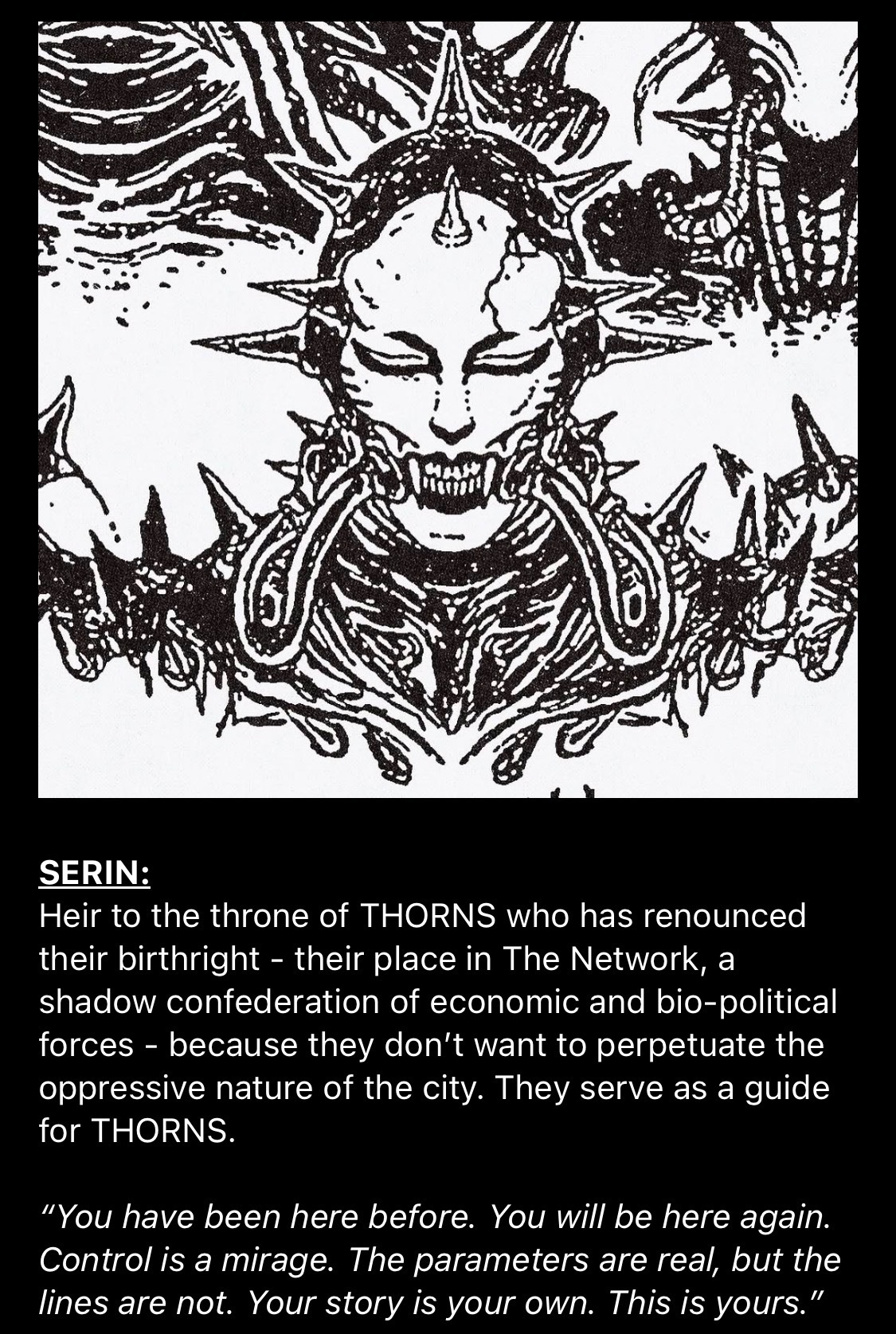
The record is based on a series of pieces and a concept by the artist Gage Lindsten.
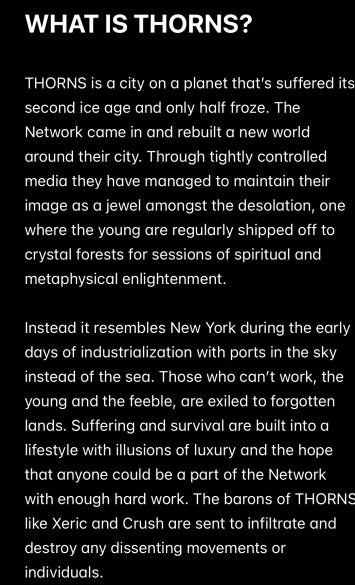
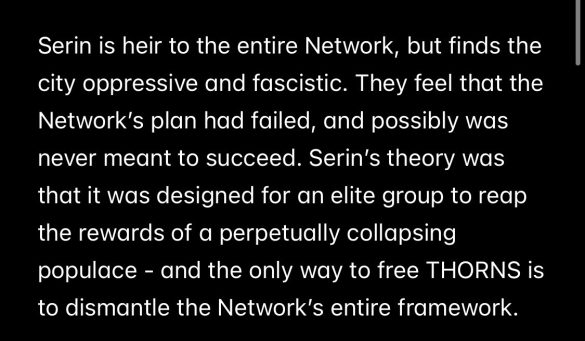
When I read that, it made me think of Neuromancer by William Gibson.
Yeah, very influenced by that.
Did you have these characters and this and this world in mind before you started making this record, or was that a thing that sort of developed as you heard the music and collaborated with all these people?
The City of Thorns was really inspired by not just Neuromancer and classic sci-fi, but just sort of what’s going on around us—traveling around in places like Manchester, areas of Belgium, near the French-Belgian border. Areas that felt like monuments to a time that felt more thriving, and also just walking around Philadelphia and seeing things where so much history that has slowly morphed throughout the eras into, you know, from thriving businesses to cell phone shops to vacant storefronts. Seeing places that were like banks, with names carved in stone turning into Subways, the restaurant, uh, and then turning into ruins and thinking about how close we are in the era of Elon Musk and oligarchy and luxury on credit, and performative luxury, how close we are to what feels like something that William Gibson would have written. That kind of atmosphere, not necessarily the characters as much as the characters of the city we live in, had inspired it.
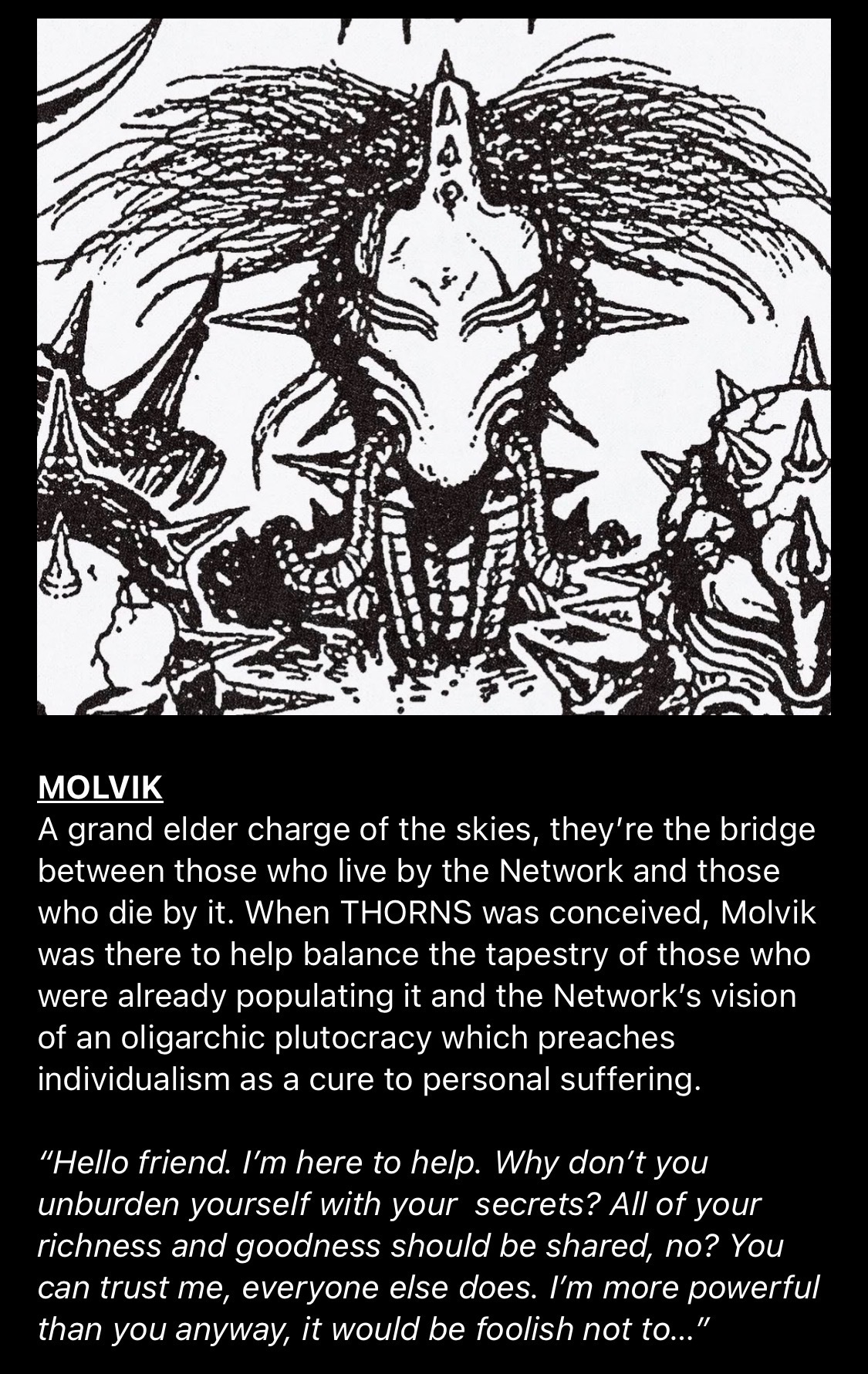
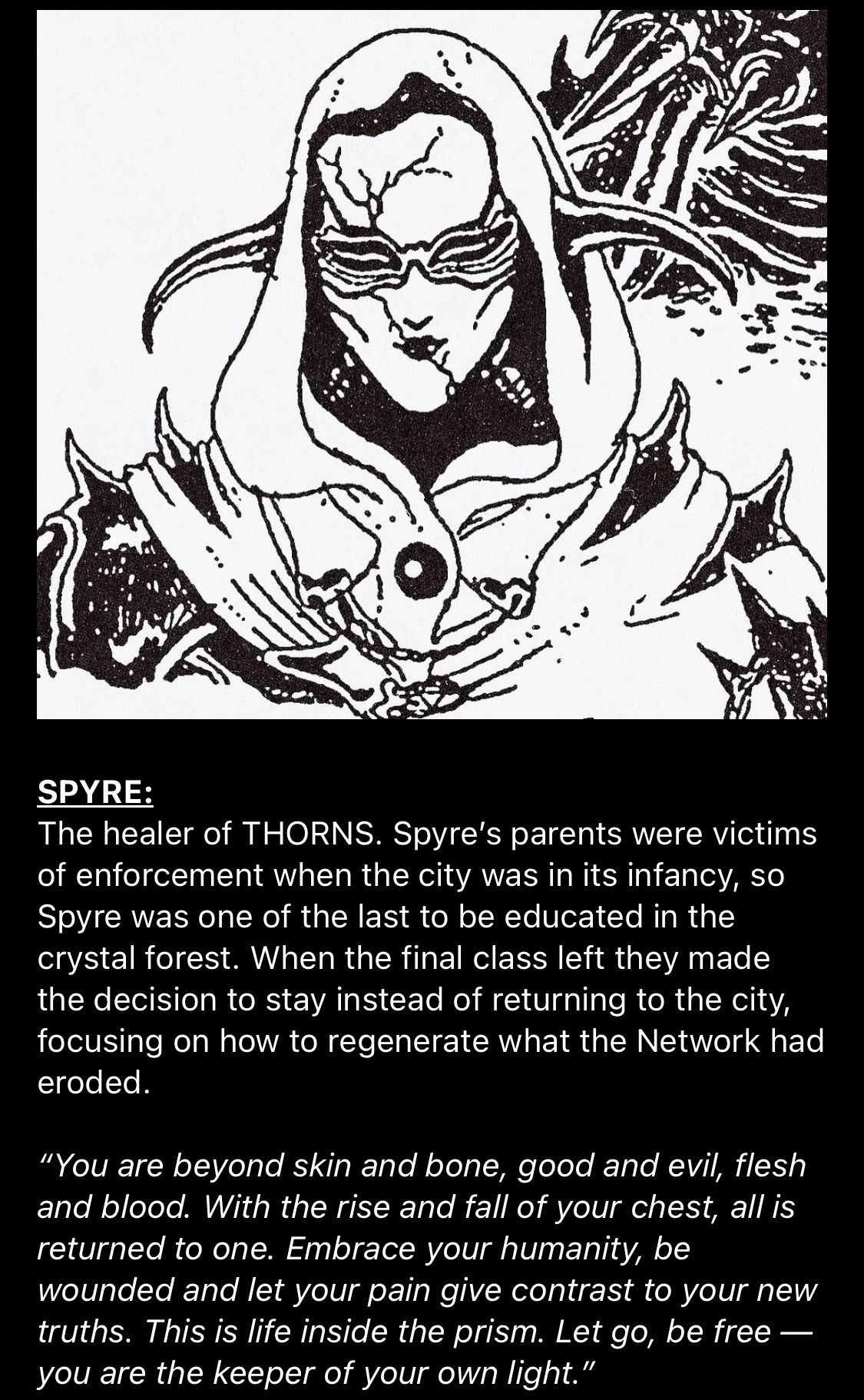
That makes a lot of sense. You sort of had this outline then and then you were able to fill it in with more specific characters after that.
Yeah, and Gage had already sort of created the visual elements, so it was a lot easier to take the visual elements and this idea of what Thorn City could be beyond those illustrations and really run with it.
Gage did these illustrations and you have this artwork and this concept for the city. What are you going to take that imagery and use it for? Is it just to inform the album and to be on the promotional work, or will they feature in more things that tie into Thorns?
Honestly I can’t tell you because right now. We’ve got the games and obviously we’ve got the packaging, but it really comes down to if people feel that this story resonates with them. I would love to expand this world. If people wanna know more about the city of Thorns and dive deeper into this world, I would love to take them.
So there’s a computer game in development about the City of Thorns and the characters?
So far the whole city is built. I’m just transferring it from an executable to a Web GL file.
I’m just trying to make it play in browser now because I don’t know Unity that well, so it’s a crash course.
I do think that today it’s more important than ever to create something that you can feel proud of. It’s in a way that is independent of any sort of modern metric system that we’ve been using now for years because they don’t work. Nobody cares anymore how many streams you have because streams are so easily faked. And you know playlisting works to a point, but it comes down to whether or not you are proud of the work you’re making. And if you can’t stand on 10 toes and be like, “This is the coolest thing and I’m proud to have made it, I’m proud to be able to show it to the world and however many people hear it, I’m stoked to have done it,” then what are you doing?
The label system has effectively collapsed. It’s not where it was even 10 years ago and the booking market and live music market is so in flux in comparison to where it used to be that you just can’t focus on any of that. You just have to be happy with what you’re making. So, you know, if you want to have a game that goes with your record, if you wanna make a tabletop RPG, if you wanna create a card game, a short film, create a whole puppet show—do it, because now is the time. You have all the resources and there’s an audience. If nobody’s doing it, you should be doing it.
Thorns has 10 collaborating musicians on it. What does it look like for you to put this band together?
Honestly, putting this band together was pretty easy because everybody who is on it I’ve worked with everyone in some capacity, for the most part. Dave Suzuki is the exception but pretty much everybody I’ve already worked with, like Claire and whatnot. It was more a matter of calling people who were the right people for this particular project, I think after this many records, I’m just sort of fortunate to have access to so much talent. It’s really a blessing.
Were people recording in their own areas and then the record was assembled? No one was in the same room making Thorns, right?
No, no, nobody was in the same room.
Is this the kind of thing where you were tweaking things constantly during the writing process, or was it the kind of thing where, once you started working on it, it was like everyone was on the same page and didn’t need a lot of direction?
The closer we got. to a finish, the less tweaking was done. So when we start it, Christian will send me stuff that I tweak heavily and as the track progresses, it becomes clear I think to everyone what needs to be done. So maybe the second or third musician might get some direction, and by the 4th or 5th musician it’ll be like, “Play what you think is appropriate for this track.”
It builds very foundationally, from the ground up, like there’s an order.
Yeah, there’s a structure to how these things work so I think everybody feels that their voice is heard on the record in the way that they’re most OK with. It feels most representative of both who they are and the vision that we all have for the track.
You have a lot of different instruments than you’d hear on a lot of Western records like PBV from Sleepwalkers playing dulcimer, balalaika, 8-String ukulele, bouzouki and quray. You also have guys like Dave Suzuki, who I would imagine that anybody reading this article knows him for Churchburn or Vital Remains. Where do you get the inspiration to go this route instead of the more traditional expectations?
Dave’s dad was Hiroshi Suzuki, who made the jazz album Cat, which is one of my favorites. Dave has always been a big supporter of Crowhurst so it was a joy being able to work with him, because I think he’s one of the greatest solo guitar players in the world. Instead of mixing him as a lead, I think having him play in a way that was texturally very interesting—our big influence was Eddie Hazel’s guitar on Maggot Brain, where it was so acid-drenched and emotional. To have that as a sort of textural backdrop was very interesting I think, even to Dave, certainly to myself. It’s just playing outside of the paradigm of what we’re used to, as listeners and as people who are creating.
PBV, they’re so supremely talented and we just worked on something together, a film score for an African film. They played those instruments and they were such interesting instruments sonically that it felt right to include them, and to include them because so much of the record has electronic tones. To have instruments that felt organic and natural really brings things down to a more human realm.
This record comes out on Sleeping Giant Glossolia in November. That’s a new label partnership for you, right?
They put out a lot of records I love and they’re just really good people.
It fits being somewhere with Ramleh and Oxbow. It’s a very fitting home for a record like this that’s less orthodox than other records you’ve done.
It’s also just that I respect the way they do things, which is, after previous experiences with labels, very important to me. If the record is good enough, it will find an audience but if a label is difficult enough, you won’t have the energy to find that audience.