Rippin’ Man
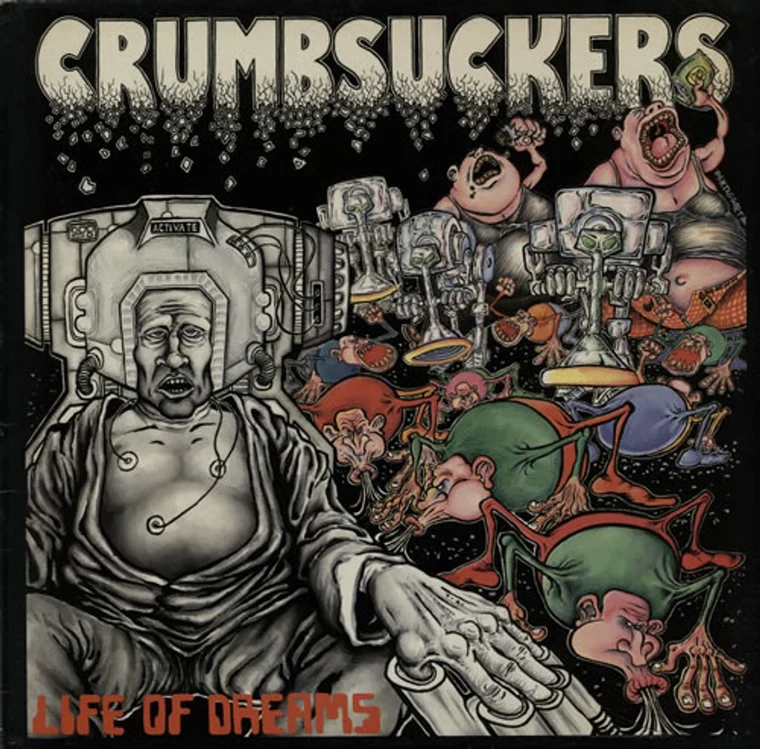
The Making of Crumbsuckers’ Life of Dreams
In the early ’80s, metal and hardcore were separate tribes. Metal arrived directly from the blues tradition; Black Sabbath started as a blues cover band before twisting the darker elements of the art into something sinister and apocalyptic. Meanwhile, punk and hardcore took the DIY attitude and pop-adjacent songwriting of artists like the Velvet Underground, Iggy Pop and the MC5, and turned them into class-conscious, two-minute bursts of energy. Although the building blocks of both genres were similar, down to chords and scales, the movements were fiercely segregated. Showing up to a metal show with a mohawk? Not a good idea.
It was evident, however, that metal and punk had much in common. Fused with anger, both spoke to the disaffected and were rejected outright by a conservative recording industry still pushing bloated prog rock and aging ’60s icons. Looking back, the underground’s second decade shows that “crossover” was quietly happening long before it was codified. Iron Maiden would become one of the most beloved and theatrical metal bands in the world, but their 1980 debut with their first vocalist, Paul Di’Anno, oozed street-punk sensibility. Venom and Discharge took the same route to immortality: hours of lessons, a handful of chords and a truckload of attitude. Even Metallica’s earliest work, driven by Cliff Burton and James Hetfield, also borrowed heavily from punk and hardcore.
What ultimately came to be known as crossover was largely a product of the hardcore scene. The earliest sparks came from the Maryland band Void and Suicidal Tendencies’ self-titled debut. Void appeared on the world-building Dischord compilation Flex Your Head, but shared little sonic ground with peers like Government Issue and Teen Idles. Their music, most notably their 1982 split with the Faith, was a proud aberration seething with frenetic guitars, uneven tempos and adolescent rage. Suicidal Tendencies’ debut was released in 1983 and mashed together metal, hardcore and a touch of funk. Suicidal would push the crossover sound even further with Join the Army and largely took a metal approach throughout the ’90s and beyond.
Crossover didn’t truly flourish until roughly 1985, as metal and hardcore fans finally realized what a pairing of the two could be. D.R.I. were pioneers and innovators, and officially named the genre with their 1987 album Crossover. The movement took the strongest hold in the Northeast and Mid-Atlantic. Some of the best crossover releases in the mid-’80s came from New York; the Cro-Mags’ The Age of Quarrel isn’t just a crossover staple, but one of the best hardcore albums ever. Agnostic Front pivoted from the pure hardcore of Victim in Pain to the crossover-heavy Cause for Alarm, and Scott Ian of Anthrax formed Stormtroopers of Death with Dan Lilker, who went further out sonically in the ’90s with Brutal Truth. Even the Misfits went down the crossover path with the metal-tinged Earth A.D./Wolfsblood; Danzig embraced metal entirely with his self-titled debut. D.R.I., Agnostic Front and S.O.D. are enshrined in Decibel’s HOF, and Cro-Mags would be if not for internecine relationships and violence.
The crossover revolution also hit the suburbs. In Baldwin, NY, a group of kids just out of high school (and one in high school) were quietly pushing boundaries and reimagining what was possible before they even recorded their debut album. The classic Crumbsuckers lineup included a hardcore singer (Chris Notaro); a bassist who later formed the NYHC institution Pro-Pain (Gary Meskil); a guitarist who adored Randy Rhoads and Eddie Van Halen (Chuck Lenihan); a second guitarist who played classic rock covers (Dave Wynn); and a teenage prodigy drummer who learned to play by jamming to Minor Threat (Dan Richardson). On paper, this combination made no sense. In practice, it unleashed a striking creativity that still resonates four decades later.
Crumbsuckers performed the material on Life of Dreams for nearly two years before hitting the studio, and the band was in a constant state of flux until settling on the lineup that recorded this masterwork. Life of Dreams is a foundational cornerstone of crossover music. The risks the band took not only paved the way for crossover, but also set the stage for acts like Neurosis to evolve from the heady hardcore of Pain of Mind into the sprawling psychedelia of Souls at Zero and Enemy of the Sun. Grab a towel, head out to Shits Creek and welcome the Crumbsuckers to the Decibel Hall of Fame the same year the album turns 40. Their induction is long overdue.
Need more classic Crumbsuckers? To read the entire seven-page story, featuring interviews with all five members who performed on Life of Dreams purchase the print issue from our store, or digitally via our app for iPhone/iPad or Android.