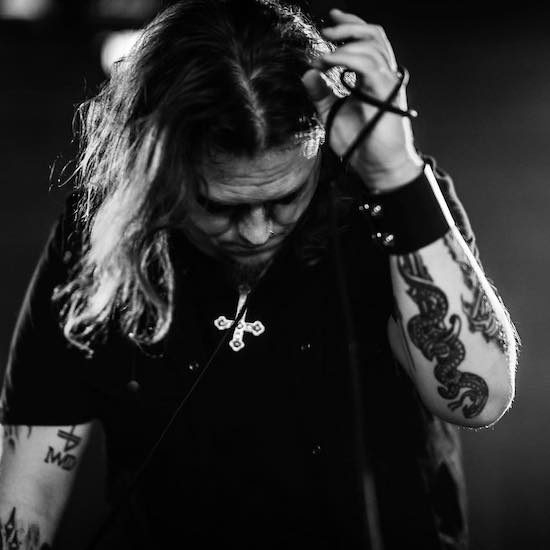
Neill Jameson is many things: one of the foundational figures of USBM, the frontman of long-running band Krieg and a longtime Decibel contributor and Hall of Fame inductee (as part of Nachtmystium’s Instinct: Decay). In addition to his deep roots in extreme metal, Jameson is also a husband and father. Jameson’s evolution from a nihilistic black metal staple to a dedicated family man isn’t a surprise to those who know him; his music has always boasted a keen self-awareness and hinted at a capacity for change and growth, even in the most abject circumstances.
Full disclosure: I’ve known Neill a long time, back to the days when this music was embraced by small groups of people and was nowhere near a global commodity with its own social media influencers. I can’t claim full journalistic distance. I’ve seen him evolve and grow in the best possible way while retaining what made him special. We are both in very different places than when we first met, but the bond remains.
Jameson’s struggles in the past year or so have been darker and more challenging than anything hinted at on a black metal recording. Roughly five years after undergoing treatment, his wife Nikki’s cancer relapsed and became more dire. His daughter, Vale, was diagnosed with Level 2 autism, requiring round-the-clock care until tailored care is available. Jameson is trying to juggle both his wife’s arduous disease and his daughter’s challenges, as well as a brutal economic climate. Without the recent efforts of the metal community, his family might be homeless.
Jameson’s struggles are far from over. His wife’s cancer battle continues to become more difficult. The initial round of GoFundMe payments will help save his house, but there are still plenty of bills to pay. In a more equitable society, we’d have free health care, and there would be systems in place to help families with serious health and financial challenges. But in our predatory system, all he has right now is us, the metal community. If you can help, even with a few dollars, please chip in. His family deserves some stability.
How did this all start?
In the summer of 2019, Nikki was having issues with bad headaches. One day, I came home from work, and she was really messed up. The headache was bad, and she couldn’t stop vomiting. I put her in the car and took her to the hospital. They found that she had a fairly large tumor in her brain and also some cancer in her lungs. By 2020, she had multiple surgeries and chemo and was in the clear. Around the five-year checkup, they found some spotting on her brain. Later, they discovered a recurrence, and it was really aggressive and had spread to her spleen and her bones. The diagnoses seem to get bleaker and bleaker. In January, she was having pain when she walked, and by February, she had to be in bed a lot. About three weeks ago, during radiation, she fell at the hospital and fractured her hip and needed a replacement. We are trying to get her into a place where she’d get the care she needs.
After Nikki’s initial treatment, were you living under the assumption that things would be good going forward?
No, that shadow is always going to be there. It never truly leaves you. You can talk to people who have been completely cancer-free for twenty years, and they will tell you that it is still always sitting right there at the back of their mind. It’s a permanent fixture in how you view the future. Her oncologist feels that the specific type of aggressive chemotherapy they gave her managed to successfully knock it out for about five years. But it never truly went away. It was just dormant.
Did your daughter come along after that initial diagnosis and after Nikki got through that first battle?
She came after. It was actually just a few weeks after Nikki got the official all-clear from her first bout with cancer. She started vomiting profusely again, and given everything we had just crawled through, my mind immediately jumped to one of two conclusions. I figured it was either a sign that the cancer had already returned and was hitting her in a super aggressive way, or she was pregnant. It turned out to be the second one.
How did Nikki manage to deal with a pregnancy after going through a cancer battle at such a young age?
Nikki is an incredibly tough person. But the reality is that the pregnancy absolutely beat the shit out of her. She was just constantly, violently sick the entire time she carried her. She was even throwing up during the delivery, so the whole experience was rough on her body. But you have to remember her baseline for pain: by that point, she had already had a part of her lung removed and a part of her brain taken out. When you’ve survived that level of physical trauma, the day-to-day pain that went along with carrying a child felt like pretty much nothing to her.
The real challenge it posed for us was that we suddenly had to figure out what the next step in our lives would actually look like. I don’t want to say we had to “figure out adulthood,” because that sounds a bit cliché, but we had to adjust our existence. It was still the middle of the pandemic when she was pregnant. Even if you took the cancer entirely out of the equation, we already weren’t going out, we weren’t socializing, partying, or going to shows anyway. In that sense, transitioning into isolation at home was the easy part. The harder part was that you suddenly start thinking about long-term stability—where you live, school districts, future security—all that kind of heavy structural stuff. We were two people who had spent years operating with total independence; she was almost 40, and I was barely into my 40s. Figuring out how to suddenly adjust to a completely different, locked-down way of life while carrying that baggage was a massive psychological shift.
Given all of Nikki’s recent medical setbacks, the aggressive treatments, and her daily struggles, what is her spirit like?
She’s keeping a poker face on, you know? She is doing everything within her power to ensure that our daughter has as normal a life as a five-year-old autistic kid can possibly have. She wants to shield her from the weight of it, regardless of the chaos swirling around this house. So, she’s staying remarkably strong for the kid and for herself. Honestly, she is handling the psychological weight of this a hell of a lot better than I am.
Because of Nikki’s illness, she can’t work. You have to be completely present for your daughter and available to manage your wife’s medical care. How are you dealing with all these competing pressures?
Even before Nikki received this latest diagnosis, we had already hit a massive wall of problems. We bought this house a few years ago, and last year alone, there was just a total shit-ton of compounding emergencies that completely and utterly drained our entire life savings. And, of course, right when our financial cushion was erased, I got let go from my job. It took me months of frantic searching to find anything else at all. The job I finally secured pays substantially less than what I had been making over the previous five years. That immediately put us even deeper into the hole.
My mind feels like it has reverted right back to how things were during the 2008 stock market crash, when I lost everything and ended up homeless. Every single day, I wake up, and my brain just cycles endlessly through panic. It reminds me of that famous line from the film My Dinner with Andre, where he talks about how when he was younger, all he could think about was art and music, but now that he’s grown older, all he can think about is money. That describes my existence. All I can worry about is how we are going to pay for the next emergency, how I am going to provide a roof over my daughter’s head, and how we are going to survive.
Then there’s the existential dread of aging. What happens to my daughter when I go? What kind of foundation am I building for her? Where is she even going to go if something happens to me? She can’t go with her mother’s family; they have shifted into an extreme right-wing space.
Meanwhile, my own family is mostly deceased. I still have an aunt and some cousins who live out in Virginia Beach, and they help out whenever they can, but they are two hours away from here. So I am completely isolated, constantly terrified about money, and buried under the standard parental anxieties of wondering how I’m fucking up my daughter, or what I should be doing differently from my own parents to help her.
You have to constantly alter your entire game plan because her brain works differently from a neurotypical child’s. Because of her severe sleeping issues, I’m essentially acting as her primary caregiver at least 23 hours a day. I have to completely suppress and push back my own intense anxiety and health issues just so I can remain functional and present for her and Nikki. And I’m honestly not very good at doing that. I am a complete mess as it is, and I haven’t had health insurance for a long time. Every single day for me is just waking up, looking around, and wondering which part of our lives will blow up today.
How is your relationship with Nikki holding up through all of this?
There is an incredibly strong partnership that you build when you go through traumatic times like this together. That shared trauma becomes the glue that holds everything together when things get completely dark. Plus, regardless of any standard marital disagreements or friction, our absolute, singular priority will always be to ensure we raise a happy, healthy daughter. That keeps us locked in.
Does Nikki have access to health insurance to cover these astronomical cancer treatments?
Fortunately, she is on Medicaid, so we don’t have to worry about the immediate hospital bills for her treatments. That is at least one massive weight off our shoulders for the time being. Even with that, there is this perpetual background of anxiety. You worry constantly about the political climate, seeing figures working to dismantle the very agencies that mandate cancer coverage or protect patient insurance. Women’s healthcare already isn’t taken seriously enough in this country, and watching the ongoing political efforts to strip those rights away means you can never actually feel safe. The floor could be pulled out from under you at any moment.
Whenever someone launches a GoFundMe, even for something necessary like a life-or-death medical crisis, you always see cynics and pushback. How has the community’s support provided your family with tangible relief?
I can tell you exactly what it means: I get to walk directly into my bank and execute a $28,000 wire transfer to officially pull my home out of active foreclosure. That right there is the difference between having a roof over my autistic daughter’s head and being thrown out onto the street. The campaign has allowed us to cover our basic living bills for the last few months, completely independent of credit cards. I did actually just get hit with a lawsuit last week over outstanding debt. My lawyer was straightforward with me—he said in that specific type of courtroom, you can’t just tell the judge about the immense medical hardships you’re enduring, because to the law, money is money; you spent it, and they demand it back regardless of your life circumstances.
But being able to clear a full year’s worth of missed mortgage payments will be absolutely fantastic. On top of that, maybe three days after the campaign launched and we received that initial wave of support, our entire HVAC system died. It turned out the unit was 25 years old and entirely unfixable. We had to drop thousands of dollars to install a completely new HVAC unit just so the house could be safely heated for Nikki and the kid. The GoFundMe allowed us to survive that. But the harsh reality is that once I pay off this foreclosure balance, we are essentially right back to zero.
What kind of unavoidable expenses do you see coming for your family over the next six to twelve months?
It’s the baseline survival: mortgage payments, food, basic utilities. And even utility costs are skyrocketing. Because of the massive expansion of tech data centers out here in Virginia, power companies are passing those development fees directly on to residential consumers. My electric bill in February of last year was around $250. This year, for the exact same amount of power usage, the bill was almost $500. Everyone feels it when they pull up to the gas pump, too—a car that used to cost me $25 to fill up now routinely costs $50 or $60.
Beyond that, we are trying to get our daughter fully ready for school, which means buying specialized clothes and supplies to help her along with her transition. It is a constant, unyielding cycle. The second you think you’ve finally managed to catch a brief breath and get an inch ahead, something else immediately breaks or blows up to suck you right back down into the dirt. That is what I’m constantly planning for.
You and I have been doing interviews and talking music for more than two decades now. Now, you are forced to confront real-life horrors that are infinitely more complicated.
I think being deeply involved in what you could easily call a pessimistic, bleak form of music for thirty years has actually helped set my mind up to endure this. I’ve gone through an immense amount of heavy shit throughout my life. Because of those life experiences, I operate under the default expectation that the absolute worst-case scenario is what will happen. Now, I fully recognize that keeping that mindset is an incredibly unhealthy, damaging way to live. It means I don’t get to experience or process joy in the same way normal people do, because even in a good moment, my brain is just entirely occupied waiting for the other shoe to drop.
When I look back at your body of work and our past conversations, real-life human concerns and suffering have been at the center of your music for almost twenty years.
Back in the early 2000s, I reached a point where I realized I didn’t want to write about the typical, generic topics found in extreme metal. At the same time, I didn’t view myself as a traditionally skilled writer who could elegantly express complex abstract philosophies on a page. So I figured, why not make my musical output entirely autobiographical? I knew that if I stripped away the theater and made it purely about my actual life, it would be inherently more authentic, deeply personal, and maybe—just maybe—serve as a therapeutic tool to help me work through my own internal damage. I think the first two goals definitely happened; the music is undeniably honest. As for that third part—actually using it to successfully work through my trauma—that is still very much a work in progress.
As someone who has watched your artistic and personal growth for a long time, it seems that everything you’ve survived has given you a distinct resilience and a certain grace.
I hope that’s true. If I were actually handling things better, maybe I wouldn’t be experiencing this total, catastrophic convergence where every single aspect of my life went to absolute shit at the same moment. My job, our financial security, Nikki’s health, and the realization that our daughter requires an immense amount of dedicated, specialized developmental support. Fortunately, we are finally getting her that help. She is starting a specialized therapy program next week that we have been stuck on an agonizing waiting list for since last September.
Navigating the cold bureaucracy of the healthcare and state assistance system while managing everything else is a full-time psychological war. On top of that, I am currently getting hit with between 40 and 50 predatory spam calls every single day from loan scams and vultures.
Once the public records show that blood is in the water regarding your home being in foreclosure, the predators completely encircle you. They text me at all hours of the night—I get texts as late as midnight from guys saying, “I can help you navigate out of your foreclosure,” but when you look them up, they just take your remaining equity and ruin you.
People have literally started showing up at my front door, banging on the glass, offering to buy my house for significantly less than the actual equity we have in it. It has reached a point where if I hear a car door slam or a vehicle drive by slowly in the middle of the night, I flinch.
Just the other day, one of the nurses at Nikki’s doctor’s office took it upon herself to call a mandatory police wellness check on our house simply because Nikki hadn’t been able to physically make it into her last outpatient session due to her fractured hip. So at 8:00 AM, I get a violent, authoritarian cop-knock ringing through the house. That happened to be the exact morning I was supposed to be in court for being sued, a date I couldn’t attend because my attorney said there was nothing we could physically do to stop the financial judgment. When you are already an incredibly anxious person living on the precipice of collapse, having the police show up at your door completely wrecks your nervous system for days. There is no place left on earth where I can go to have a quiet mind. I can’t even look at my phone to escape or distract myself for five minutes because I am being constantly pounded by predatory calls, texts, and threatening emails.
What does a realistic road back to some semblance of stability and normalcy look like for your family? Ideally, how would you like to see things roll out to establish some structure?
Right now, even if Nikki’s hip wasn’t broken and she wasn’t completely bedridden on the mend, I would still have to physically be in this house around the clock to take care of her and our child. What would really change the game for us—and what I’m desperately hoping for down the line—is her upcoming therapy schedule. It starts at two hours a day, which will at least give me a brief window to do basic things like cut my lawn, which is currently sitting up to my knees. But eventually, the goal is to transition her into a full-time program.
That window of time would finally open up my physical ability to try and get some consistent income coming back into this house. I am actively trying to find a viable pathway back into school to complete a degree or secure professional certifications that will improve my job prospects. True normalcy means being able to secure a sustainable job that allows me to earn enough to ensure my family isn’t constantly scrambling to survive. We don’t want to live like kings; we need baseline stability. I need to get back to a point where I can reliably work and protect my family, because no matter what the medical outcome is with Nikki, I am going to be solely responsible for our daughter’s entire future. I need to be a permanent, stabilizing force. But to do that, I also desperately need to find a way to get health insurance so I can get back on the medications that keep me functional. I know exactly what is broken inside of me; I just need the structural support to work through it. I need to summon the mental fortitude to keep providing and ensure my health holds out long enough to see my daughter through.
What has the support from the heavy metal community and the independent music scene meant to you and your family?
It has been completely, blindingly overwhelming. For a subculture and an online community that spends roughly 90% of its public existence completely shitting on one another, the fact that so many individual people have collectively mobilized to rally around us—whether through financial donations, sending incredible messages of encouragement, or constantly sharing the campaign link—means far more to my family than I can ever articulate. It also fills me with a strange sense of guilt, because I know firsthand how financially strapped everyone in the independent music scene has been over the last few years. Everything has gone up. Record labels are struggling because no one has discretionary income for physical media anymore; a single vinyl record that used to cost $20 a few years ago is now routinely priced at $35, and the independent shops are barely making a profit on them.
So the fact that everyday people are actively putting aside money that they could have used to buy a beer or enjoy their own lives, and choosing instead to send it to my family, is an immense act of grace. I think people often fail to realize the sheer, transformative power of a wide net of ordinary people donating just $5 or $10. It doesn’t need to be a massive corporate sum to alter a family’s trajectory. When someone messages me and says, “Hey, I don’t have shit right now, but here is $1,” that gesture carries genuine comfort. It proves to me that humanity isn’t entirely comprised of the predatory garbage we see reflected back at us online or on the news. It proves that the community within this music is completely real and that it remains incredibly strong regardless of the massive obstacles facing us all. It’s the only reason we are still standing.
Neill Jameson and his family still need help. If you are able to contribute, please visit their GoFundMe page. In addition, please consider sharing this piece via social media.