Despite their short time as a band and even shorter discography, Void is one of the foundational bands in extreme music. Void formed in suburban Maryland in 1980 and quickly earned a reputation as one of the most uncompromising and confrontational bands in the underground. Although the band released all of their music on the D.C. label Dischord, their music was, in many ways, different from that of their peers.
Void’s volatile mixture of hardcore and metal gave birth to what would eventually be known as crossover. A strong case can be made that the best works by bands like Agnostic Front, Stormtroopers Of Death, Cro-Mags, and others exist because of Void. Even Pig Destroyer credits the band as an influence and covered “Who Are You?” on a hardcover collection included with Book Burner.
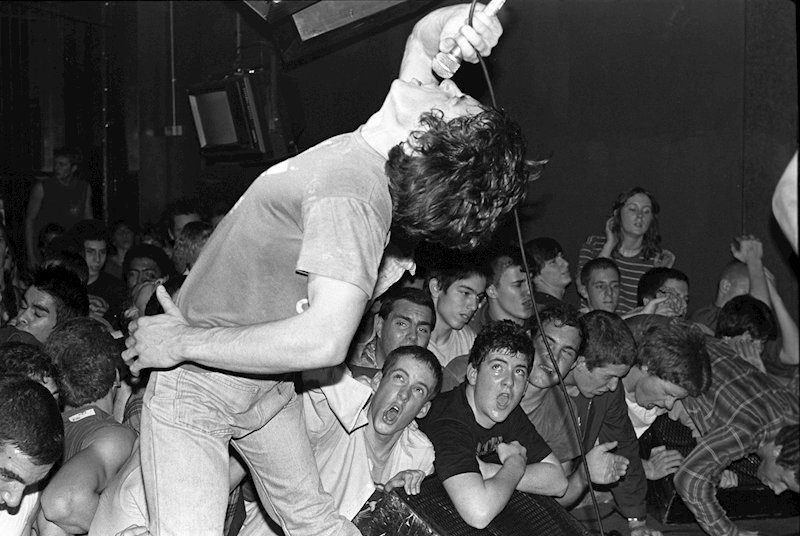
Live 1982 contains two watershed Void performances. The A-side documents Void’s April 1983 performance at the Wilson Center, just months before the release of the legendary Faith/Void split LP. The B-side captures a December 1982 show at the 9:30 Club, where Void played with Negative Approach. Tom Lyle of Government Issue professionally recorded both performances. The release features photography by D.C. hardcore documentarian Jim Saah and artwork by Dischord designer Jason Farrell.
Live 1982 was released this month on Outer Battery Records. Bassist Chris Stover talked to us about how it came about and what it’s like to talk about a band that lasted for roughly three years, four decades later.
You’ve had a full life and career outside of music, working in real estate and tech. Did you ever expect to be still talking about a band you were in for a few years during your late teens and early twenties?
Stover: I didn’t think anything of it. We just enjoyed it in high school. Other than Bubba (Dupree, guitarist)—who took it full force and wanted to be a full-time musician—we didn’t think about it beyond that. We were doing what our parents told us: going to college. Sean (Finnegan, drums, RIP) played in bands for a brief period in college, but only jammed.
What do you think it is about Void that still resonates 30 or 40 years later, especially for people discovering it today?
Stover: I wish I had the magic answer for that. I think it’s the elements of metal mixed in with the completely unhinged sound we had. That’s something people still gravitate to.
How did the live record come about?
Stover: Tom Lyle was the impetus for it all. Over the last 10 years, there’s always been talk about doing something with the old live recordings. Outer Battery originally released a live Faith record at CBGB’s, and soon after, Tom stepped in and said, “If you’re doing that, you have to do a Void live record.”
When you sat down and listened to those recordings, what did you think? Did they capture the band properly, flaws and all?
Stover: They did. Tom was doing the sound back then, so he had the original direct-board recordings and manipulated them as best he could to make them clearer. I’ve heard them over the years in passing. I made mental notes like: “Wow, I really wasn’t playing bass well that night,” or “Sean was off,” or “John(Weiffenbach)’s vocals are barely there.” But Tom did a really good job gleaning what was good.
I appreciate that you didn’t try to hide any of the flaws. There’s a recklessness to Void that people love.
Stover: Exactly. When we practiced—and we practiced a lot—we really focused on playing well. But once we hit the stage, all bets were off. The gloves came off, and it just happened the way it happened. Void wasn’t a perfect band when it came to grooves or timing, and this record definitely captures those live moments. As my friend Kenny Inouye (Marginal Man) says, there were two schools of thought about Void: you either loved us or hated us.
Dischord eventually released a lot of your archival stuff, but are we ever going to see a proper release of the Potion for Bad Dreams sessions, or will that stay on the internet forever?
Stover: Nope. I go along with Bubba on that one. For me, listening to that is like looking back at the paperwork of your divorce. It wasn’t a pleasant time because that was the end of the band. It’s just not a great sample of where the band was.
What was the songwriting process like back then?
Stover: Sean was the main songwriter. Because he was the drummer, he’d have a rhythm in mind, and he also wrote the best lyrics. He’d parlay that to Bubba to come up with a riff. Those two would work together to build the whole song, and then John and I were sort of the silly putty or glue that filled it all in.
The new live record initially said 1982, but one show actually took place in 1983, right? What do you remember about that night at the Wilson Center?
Stover: That was a misprint that Tom and the rest of us corrected. Honestly, all the Wilson Center shows kind of blend together. It wasn’t specifically about one particular show; it was about the experience of being there. It was incredibly community-driven. When you see old flyers with all those amazing bands playing together, it really was a community. No one was driven by ego. We just wanted to get out there and enjoy it. We tried to figure out how to tour the U.S. like other bands were starting to do, but we quickly realized we needed money to do it.
One of the real things lost in our lifetime is that sense of a community birthing a scene and lasting friendships. Crossover punk and metal really took hold around 1985, and Void definitely helped get the ball rolling.
Yeah, I agree. Our idea was always just to get out there and enjoy it. All the children get to reap the spoils. Bands after us were able to have bigger records and go on tour. It’s one of the cases where the progenitors didn’t really get to that level. Success is the wrong word because it was still shitty clubs (laughs).