
In Living Color
The Making of Boris’ Pink
Wata, inscrutable as the Sphinx, slips imperceptibly into the chair across from me. Upstairs in the commons area of a 1930 house in downtown East Austin, the guitarist sits first, followed by bandmates Atsuo and Takeshi. The return of the Japanese noise triumvirate to this evening’s club looms in hourglass terms, yet Boris settle easily around the small kitchenette table central to the quaint, light-dappled space straight out of That ’70s Show.
A few blocks away, in the dusky shadows of the Texas Capitol, a main interstate artery clogs during rush hour. Over a dozen people helped manifest this Halloween-adjacent summit at the administrative HQ of local barbecue magnate Aaron Franklin. Sand begins falling through our timepiece the moment three figures in black exit an Uber their tour manager flagged them a mile away in the heart of the “Live Music Capital of the World.”
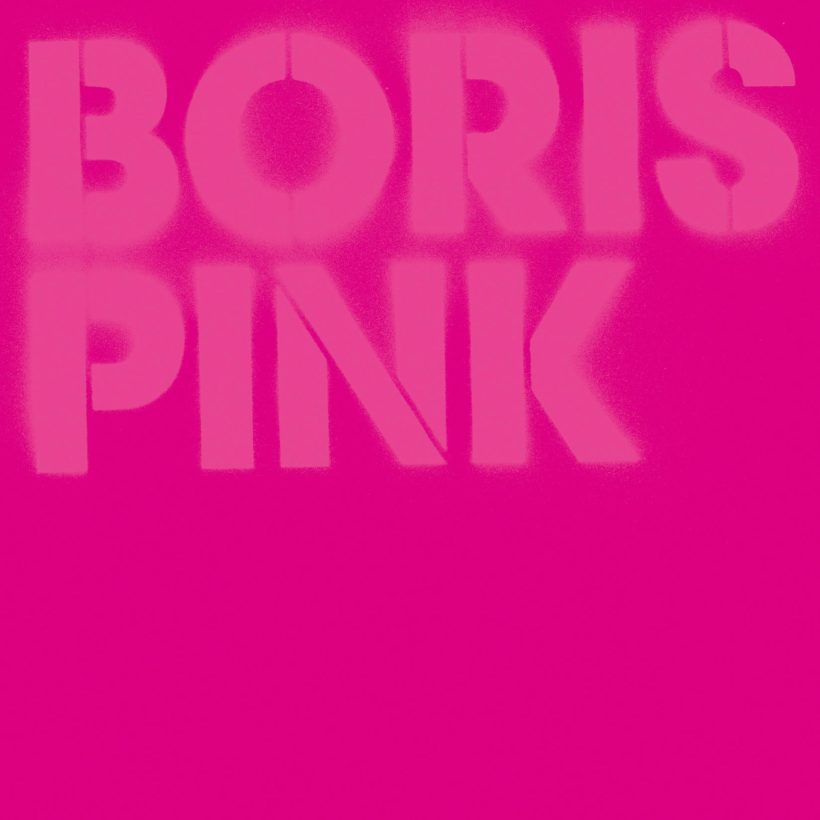
Marking the 20th anniversary of the band’s universal close-up, the “Do You Remember Pink Days?” tour syncs its fifth stopover to a locale playing into that narrative. Even so, while proving ridiculously convenient for the business at hand herein, it nevertheless occurs serendipitously. Because ultimately, the juncture at which an album makes popular culture pause and take note happens but once in a lifetime—initially, anyway—and that spotlight caught Boris dead-on atop 2005 projectile Pink.
Musashino Art University serves Earth’s most populous city, Tokyo, and thus conjoined Boris, iconically titled for the sludgy, Sabbath-y, possibly homicidal opener to third Melvins’ full-length Bullhead. Like grunge and post-punk before it, the trio ramrodded ’70s U.K. classicism through ’80s domestic DIY, detonating majestic crunge with garage-band animism. Founded in 1992 and winnowed down from an original quartet to its current configuration four years later, Boris still wield said hammer of the gods, one originated in a culture vastly different from our own.
Pink, released on hometown label Diwphalanx in November 2005, then through Southern Lord the following May, streamlined the group’s eruptive experimentalism across an uninterrupted streak of feedback-torn LPs plus countless singles, EPs, splits and collaborations. Psychedelic, voluminous, heated, their full metallic spasm rippled the music sphere like Shelob.
Beginning with “Farewell,” Boris teases a moment of six-string luminescence that blooms into the proverbial burning bush. Live, Wata’s flamethrowing SG crisps most of the bandwidth, while Takeshi mans bass and second guitar on a double-neck, and band alpha Atsuo gets it on gong and all upon the drum throne. In-studio, the two guitarists push the boundaries of that dynamic, filling channels with whitening noise pierced through by riffs as bright as airport runway lights.
A mere 7:33, “Farewell” touches off the album’s chain reaction at doom tempo, limbering up sonic boundaries as well as emotional ones in cycling methodically from nothingness—the birth of sound—to Takeshi’s full-blown vocal ascension. Whether in Japanese or English, his singing on Pink seeps corrosive nostalgia: yearning, gnashing, crooning. The title track then hits the gas, full burners, encompassing or perhaps engulfing the whole of that era’s high-desert California scene—ripping, bubbling, boiling over like god’s own water implement.
“Woman on the Screen” floors it one better, burning nitrate until 2:17 blitz “Nothing Special” devolves from full-bore expulsion to a primal burble that finally bursts, spraying disintegration guitars and neutron bass over Takeshi’s hardcore vocal. Peak pounder distinction belongs to two-thirds point “Pseudo-Bread.” Clattering ’60s psych that inverts into ’90s grunge, it’s a behemoth stomper as big and hairy as Bigfoot, yet Takeshi’s vocal hook remains one of the most melodic in the Boris canon, the accompanying riffs literally that—canonical. Pink then saves its best for last.
Closer “Just Abandoned Myself” delivers a blistering crescendo to the disc, disgorging an 18-minute afterburner of pure power and propulsion, three musicians interlocking into a far greater battering ram of guitar, bass and drums headed straight for the Freudian ID. Every great group becomes its own continent, and “Just Abandoned Myself” erupts a volcanic interdimensionality burning down into six minutes inside the Boris sound crematorium.

All of which contrasts sharply with the three extremely modest individuals sitting across from myself and a translator. At the state’s flagship university nearby, my journalism students direct me to the Department of Asian Studies, yielding the UT Japanese Association president. As it turns out, charismatic civil engineering senior Tomoya Tanaka proves my secret weapon since the Mizunos—Wata and Atsuo—share a daughter, and Takeshi Ohtani wears a wedding band, so odds lay even he’s a parent, too. Tomorrow’s builder of bridges charms us all.
Because the real-time Japanese-to-English transcription software on his phone generates AI trash, and although he valiantly summates answers, I eventually wave him off and simply pitch questions into the void—not knowing the answers until three weeks later. Relishing an enduring tome written in another language means marveling at the high art of interpretation, so musicdom owes Tanaka a debt of gratitude, because almost no in-depth, career-ranging interviews involving all three members of Boris exist between the ones the zeroes.
Before yours truly chauffeurs the band back to three tiers of Austin live venue Mohawk outdoors, each member turns to me pointedly once during the inquisition—of which nearly every word appears here—and stresses something in English.
Atsuo: “Deep. Purple.”
Takeshi: “Geddy Lee.”
Wata: [prior to doodling a smiley ghost while autographing my Relapse Records reissue of the business at hand] “Live at Pompeii.”
Detonate the fireworks, then. Let the magma flow. And in 2,000 years, when archeologists dig out the Decibel Hall of Fame from the fossilized remains of “civilization,” let the record show that Japanese sound sovereigns Boris looked best in Pink.
Need more classic Boris? To read the entire seven-page story, featuring interviews with all three members who performed on Pink, purchase the print issue from our store, or digitally via our app for iPhone/iPad or Android.