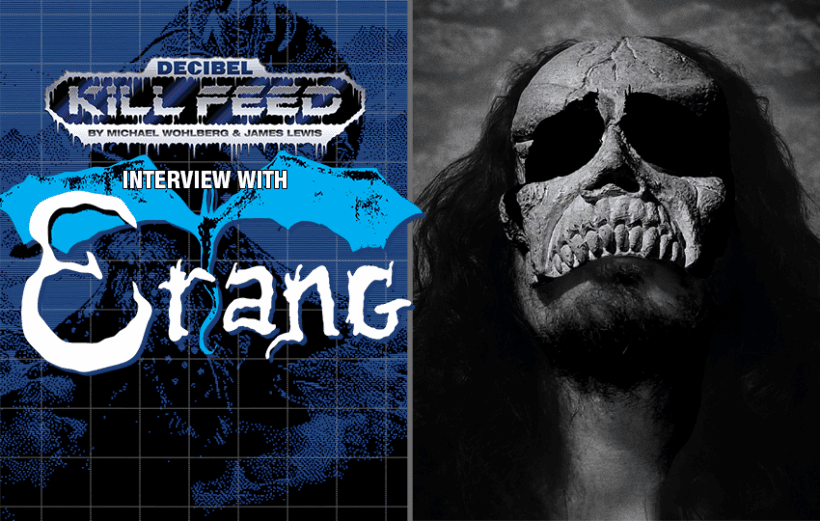
For the more adventurous explorers of the underground over the last few years, there are two words of power you have likely encountered during your travels: “dungeon synth.” While most people’s exposure to the subgenre revolves around Mortiis and a certain codpiece, those who peaked behind the curtain of memes found a passionate and quickly-growing following. Amidst those championing the revival of the craft is France’s Erang, a solo effort dedicated to dungeon synth and medieval fantasy music (and sometimes synthwave) since 2012. This skull-faced artist isn’t content to simply whisk listeners away to a nameless European forest. He instead constructs the soundtrack to a world of his making, the Land of Five Seasons, and with a total of 27 albums released across 13 years on top of short stories, videos and illustrations, that’s a hell of a lot of lore to get through.
Escapism certainly plays heavily into his sound, but it’s Erang’s life experiences that have helped shaped his domain. Explained on his website, the electronic musician’s work is “inspired by my own nostalgia about places, people and events of my past, forever lost…” Among those influences are a childhood filled with high fantasy novels, movies, tabletop RPGs and—you know what column you’re reading—video games. Kill Feed may be a video series at this point, but at the request of the artist, we have returned once more to our text-based adventure for one more quest in the name of imagination. Though his kingdom claims his attention the majority of the time, it’s his latest release Tome Zero as well as our shared interest in the digital medium that has lead the keyboard warrior to step within the neon lights of our arcade and share tale of his gaming past, present and future.
What was your very first video gaming experience?
My dad used to have computer. In fact, he bought us Amstrad CPC 6128. I don’t know if you are familiar with this brand, Amstrad. It was an old computer with a floppy disk and stuff. It was a time when you didn’t really have a game on a cartridge—it was just big boxes with many floppy disks. You would pick them up and see what happened. There were some games like Bomb Jack and Boulder Dash—those were really ancient games. After that, I had an Atari. We played Speedball 2: [Brutal Deluxe], this futurist football game. That’s the most ancient video game memories that I have.
When you played those games when you were younger, do you remember having enthusiasm about them right away? Did they have you hooked as soon as you first played them?
Yeah, because it was really like another world, you know? The beauty with these games back in those times, they were all hacked. We didn’t buy them. It’s like as I said, a big box of floppy disks, so you didn’t have any instructions coming with them. You just put the floppy disk in and see what happens. That hooked me because just having the game start was already an experience in itself [laughs], after putting maybe five, six or seven floppy disks and then it started.
A big memory that I have from this time: Sometimes at the beginning of those games, you had some very short demo animation, and they were made by the guy who hacked the game. It was like his signature he put at the beginning. You had this weird animation and it was really very intriguing for a young kid.
Did you continue with gaming throughout your entire life or were there any points that you stepped away for a bit?
No, not my entire life. In fact, I stopped maybe between 17 and 18. I sold pretty much everything and I kind of regret it today. I sold my N64 and my Super NES and all the games. I was born in 1982. During the ’90s, gaming was not as huge as it is today. It wasn’t a cool thing or a community thing. I’m exaggerating a bit, but you were a kind of a nerd if you were playing video games in the early ’90s, so when you became a teenager and you were 17, you maybe had other kinds of interests. It’s not the same thing as today, you know? So, I stopped because I was into other things. I came back to this maybe six years ago a little bit, and three years ago a bit more.
What was it that brought you back?
Divorce. I stopped playing games for a long time because I was into other things, as I said. And then after that, I was really into my music. My main interests have always been creativity—music, drawings or to write—more than playing games, always. For the last 13 years, I’ve been focusing only on Erang and my music. But then at some point, I divorced from my wife and I’ve been on my own in a new apartment, with my daughters from time to time. So, I thought maybe because I’ve got a bit more free time, I decided to go back a bit and play video games.
But even if I wasn’t playing, I’ve always kept an eye on what was going on because the aesthetic, the visuals, the music always interested me very much. For example, even if I wasn’t playing, I saw the documentary Indie Game: The Movie. I truly love this documentary. I’ve always kept an eye on what was going on because it was interesting to me. It was really just a matter of time and organization because I wasn’t playing. So, when I decided to try my hand at it again, I downloaded Steam and the first game I tried was Braid because of Indie Game: The Movie.
Are you exclusively a PC gamer now or did you pick up any consoles since you started playing again?
No, PC only.
Any particular reason? The excitement about those indie games or you’re just not really interested in having the consoles around?
Both things. Because my main interest obviously is my art and music, I’m working a lot on my PC. It’s like an extension of myself, so it was totally natural for me to play on PC. Actually, I had a Nintendo DS, but that was it.
So what have you been playing since you came back and what are the games that you prefer to play these days?
I started with Braid, as I said, then Fez. [Laughs]
Then you had to go Super Meat Boy, all the games from Indie Game: The Movie…
Not Super Meat Boy, because I wasn’t skilled enough.
[Laughs] Neither are we!
That’s an interesting point to bring up. The kind of games I like, it’s really the atmosphere that’s the most important for me. Obviously I’m a casual gamer now because I don’t play often and I haven’t played for a long time, so I can’t and I don’t want to play difficult games. It’s not my cup of tea. I’m looking for atmospheric stuff and something where you can immerse yourself—kind of the same thing I’m looking for in music and art in general. In movies, for instance, I’m a huge fan of David Lynch. Atmospheric stuff really speaks to me.
So, to answer your question, I’ve played Braid, Fez and then… I don’t really remember. I’ve tried some really indie stuff, [like] Knytt Stories. It’s from a really independent guy; a little platformer. I had a short phase where I was looking for games even outside of Steam, made by one guy alone with really crude and raw graphics. You go on the website of the guy and you download the game, it’s free and you try it. I was always looking for that weird vibe. Actually, at the same time, I was also trying a very little bit to make my own game with an engine called Construct. But to create a video game on your own, it’s definitely something else, you know? It’s much harder than doing a music album, to be honest. [Laughs]
Why that engine in particular? Understanding that it’s a slow process to learn everything that goes into a game, how do you feel it’s been going learning [how to develop] a game?
It was very interesting and, as you’re saying, it makes you realize that it’s so broad, all you have to know and deal with, because you have to think about every aspect to write, to code obviously, to make the graphics, the music and the story, et cetera. The engine was Construct Classic and it was fun to play with it. I chose this one because I was looking for an engine where you don’t have to properly code, something visual. And at the time—it was maybe seven years ago—this one looked easy to use. I actually made some very, very basic stuff; one or two levels in the game, but very, very basic.
But still, in the back of my mind, maybe one day I’d like to make something with Erang because I’ve made this promise to myself to make one piece of art in each medium that I like. Obviously music is done, but I will keep it up. Right now, I’ve almost finished a book, a collection of short stories in the style of The Twilight Zone, The Outer Limits, Creepshow, that kind of stuff. It should be out before the end of the year or, more likely, at the beginning of next year. I’d like to make a comic book. I realize that it’s a lot of work, but as I said, I give all my life and heart to Erang. I’m really doing that during all my free time. Maybe one day to have some short, independent video game related to my world, that could be cool.
Have you given any consideration to what your approach to a video game surrounding the Land of Five Seasons would look like?
If I ever try my hand at doing a proper video game for Erang, obviously I will have to take into consideration my skills and the difficulty to make the game—so it wouldn’t be [The Elder Scrolls V:] Skyrim. [Laughs] But the thing is, because it’s related to dungeon synth, people would be okay to have vintage or crude graphics, and maybe some kind of text adventure with pixelated images to illustrate, like a kind of interactive book. Maybe something like Myst, the first one with a fixed image, you click somewhere on the image and then you open a chest, you find a sword and stuff like that. That would already be difficult enough to make, but manageable. So, maybe something very vintage, to bring my world into that.
Let’s say you wake up tomorrow and have expert coding skills. The sky’s the limit, you can make any game you want. What kind of game would you make? Would you make something that would be tremendously huge and immersive like a Skyrim, or would you rather go with something a little more text adventure, imagination driven?
That’s a difficult question. I’d like to answer both, if possible. Both would be cool because obviously something like Skyrim, bringing the Land of the Five Seasons to this kind of game would be incredible. But to have something more atmospheric and minimalist would fit the build, too.
In a video entitled “An Education from Fantasy to Dungeon Synth,” you single out the Secret of Mana OST as being exceptionally important to you. What is it about that soundtrack in particular that means so much to you?
First, even if you put the nostalgic aspect aside, it’s beautifully composed. Even today, if you’re listening to it or an orchestral version of it, it’s just beautiful. It’s very diverse, you have a very strong emotional part. And then if you put on top of that my nostalgia while I was playing it, this game was very gorgeous visually when it came out during the ’90s. You could play three players at the same time and it was really a beautiful game. The music is just awesome and even more when you realize, like with all those games from back then, the technological limitations that they had to make the soundtrack on the Super Nintendo, it’s even more impressive.
What other games have been impactful to you both in terms of music and storytelling?
If we are talking about gaming during the early ’90s, it wasn’t really the story, so to speak. It was much more the atmosphere. For example, I was a big fan of [The Legend of] Zelda: A Link to the Past. Honestly, I don’t remember the story. I presume you have to rescue the princess. [Laughs]
I [James] mean, there’s a story, but realistically, the story is, “fight the evil wizard, rescue Zelda.” That’s the story.
Yeah, no, no, you’re right. What I mean is that those games, they left a mark on me much more because of their whole atmosphere. If I’m comparing that again with David Lynch, you can’t really tell the story of most of his movies. You just have vibes, atmosphere and things like that. But you can’t say, “This is the story”—and, in fact, it doesn’t really matter for that kind of stuff. And it was the same thing for me. Secret of Mana or Zelda: A Link to the Past, I don’t really remember the story. But it was just to drown myself in this other world with the visuals, the music and you are playing during the afternoon and your mom is doing stuff and she yells at you to stop. [Laughs]
It’s the full package. I have a clear picture of me in the living room playing these games and with my parents around because I didn’t have a TV in my room. My cousins were living nearby, so they came to my house or I would go to their house and we were spending the afternoon playing Mario Kart and Bomberman. So, it’s really an atmosphere. Also, speaking about game music, Donkey Kong Country, this is in my top 5 video game soundtracks, probably. It’s really innovative and beautiful.
In your videos, you talk about how your father was really into science fiction and he would read you stories like The Hobbit and The Lord of the Rings. You mentioned that your brother was instrumental in introducing you to tabletop gaming and heavier music. You’re talking about the TV being in a shared room and having your parents around, going to spend time with your cousins. Was the community aspect of video games—and art in general—an important aspect of why it was so impactful in your upbringing?
About my whole upbringing, I couldn’t really tell. But about the fun and the strong memories I have… You can’t reproduce that feeling of being 10 years old and playing Mario Kart with five kids in the living room and shouting and unplugging your controller right when you are going to win—or they press reset. That was my brother’s stuff. We were playing Street Fighter and when he was about to lose, he pressed the reset button on the Super Nintendo. And later we played a lot of GoldenEye [007] on the N64; that was incredible. You could have four people play at the same time, so we were playing a full day, a full weekend of GoldenEye, and it was crazy to play those games together in the same room when you are a kid. That was incredible.
Obviously being able to play online is good and it brings people together; it’s good that that exists. But do you think that younger people today are kind of missing out because they’re not getting as much of that experience of playing in the room together?
I don’t really like to say who is missing what. Every generation is different and I’m probably missing a lot of things from today because I’m 43 and not 12 years old. For instance, I don’t play multiplayer online—I just play alone. I’m sure that if I was younger today, a teenager, and I could play online with several people, I would have a blast. I guess it’s a different thing, and I don’t think they are missing anything because they don’t live that. You can only miss what you experienced, really.
You had mentioned that you typically go more off of vibes with video games and atmosphere—atmosphere is a big part of it—but you also mentioned that you need to play games that are a bit more in your skill set. Have there been any games that you felt like the atmosphere was really incredible, but that difficulty curve was just a little bit too much for you?
I don’t think so, because when I’m looking for a new game I check that before so it doesn’t happen. I would like to try Elden Ring for example. But I know that I wouldn’t go far, so I didn’t even try.
Much like underground music, the video game industry has a rapidly growing indie scene with a number of games being made by small teams or even single person developers. As with your interest in bedroom projects, do you find yourself more fond of seeking out the smaller indie titles versus the bigger AAA stuff? Do you prefer to pick up on Steam the smaller projects versus whatever the latest AAA project is?
In an ideal world, I would definitely try to check a lot of small independent games. But today, because I have a really short time to play games… When I say that all of my free time revolves around Erang and my art, I’m not lying. And even more than in my free time, even when I’m working, I’m thinking about what I could do or I’m drawing on the computer or keeping ideas and stuff. I’m constantly working and thinking about Erang and my music and my art.
I don’t go outside often by choice, because I prefer to stay home and work on my stuff, to do creative things. So, I really have a short amount of time when I decide to play and say, OK, stop, I just need to… I wouldn’t say “I just need to relax” because I love doing art. It’s just at some point I say, OK, I will play some games today. And because of that, sadly, I don’t have the time to dig into all the small independent games, so I prefer to find something that is maybe a bit more well known.
When I came back to playing video games six years ago, I started with Braid and Fez and stuff like that, and then I stopped a little. And three years ago I decided to play Skyrim because I’ve heard about it for a long time and I wanted to play a big fantasy game. Everybody was saying that it’s a very atmospheric game and an easy game, it doesn’t have a really high difficulty. It’s pretty much the only game I’ve played since. I launched Skyrim three years ago and I’ve made one character named “Erang.” I only have one character in Skyrim and I’m playing the same one since three years ago.
I think I’ve only finished the main quest one year ago. I was wandering into the country of Skyrim just to enjoy the atmospheric aspect of it. I wasn’t interested in finishing the game or doing the main quest—I was just wandering into the landscape and discovering caves and stuff like that. That was a really cool experience. So, to come back to your question, because I have a short amount of time to play, I know that if I launch Skyrim, I go back into this world and I play for a few hours and it’s good. But in an ideal world, if I have more time, I definitely would like to try hundreds of small independent video games because I find their aesthetic and their ideas excellent. I’ve played a few small games from time to time. I don’t have the names in my mind right now.
“I launched Skyrim three years ago and I’ve made one character named ‘Erang.’ I only have one character in Skyrim and I’m playing the same one since three years ago.”
Are there any classic consoles that stick out to you for their sound capabilities? Have you ever tried to emulate a sound from a particular console?
Definitely, 100 percent. I’ve even directly used sounds from Donkey Kong Country, Zelda, Secret of Mana. I tried to find on YouTube some people playing the same keyboard that was used for Donkey Kong Country. I sampled and recorded a few sounds that were the same, used in the game, tweaked it and put it in some of my tracks.
I [James] am also a huge fan of the Donkey Kong soundtrack in particular. The composer is David Wise, and he just did some magic. That soundtrack, the first two games, are just absolutely phenomenal.
Yeah, exactly. And technically it’s very impressive because it kind of emulates the KORG synth that he used in the Super Nintendo, and that’s really impressive.
Yeah, that technical limitation is very limited. For as beautiful as orchestral soundtracks for video games these days are and as much as you can do with them, like you had mentioned earlier, that technical limitation really does breed that creativity to come up with something. The Donkey Kong soundtrack that stands the test of time as opposed to another multi-million dollar orchestral soundtrack for whatever AAA game comes out.
Exactly. For me, paradoxically, limitations are freedom. When you have access to anything, you are not free. You are in a mental jail because you can’t choose. You don’t know what you want to do and you are spoiled by everything. But when you have limitations, you have to take the best out of it and make something with it, and it’s always better for the imagination. If I give you a piece of paper and 100 pencils with all color variations to make something, it will probably end up in a mess—except if you are Leonardo da Vinci, maybe. But if I give you just a red pen and a black pen and I say, “Do something,” you will be forced to use your imagination to create something unique and different. Limitations in art is always for the best. I would even go as far as to say that maybe in some aspect of your life also. If you have access to everything, everything loses its taste.
By the time this interview is published, you’ll have a new album out entitled Tome Zero. You shared a few images on your Instagram that you said were direct influences on this new release. Were there any games that helped inspire the content of this record, or possibly any games that you personally associate with it just by sheer chance of playing it while you were writing the record?
For Tome Zero, I don’t think there is truly a conscious video game influence, but if people listen to it there will be many kinds of video game sounds or synth patches that sound like some old video game from time to time. There is no obvious or conscious influence, but in pretty much all my albums you will have in some tracks some sounds from that era. Sometimes it’s totally conscious and sometimes it comes to me. With dungeon synth—it’s the same with many other musicians—you can’t avoid that influence.
In your “An Education” video, you also describe how your brother introduced you to tabletop gaming and your memories of being enamored by the art. Do you have a preference between tabletop gaming and video games?
Definitely video games. You talked about my elder brother. So, you can imagine how it works: All of the older teens are playing and you are kind of gathering around the table doing a small part. [Laughs] I wasn’t really involved in the party that they were playing. Usually I was watching or I had a character sheet and—the young brother at the table—not taken very seriously in the game because he’s five years older than me. I was much younger than the other players.
But it was enough for me to be influenced by this world, tabletop RPG, the art. I still have the boxes from the Middle-earth RPG from my elder brother. And I played HeroQuest a lot with my cousins. So, I had much more experience on my own playing video games than tabletop RPG.
Despite the fact that you had much more experience with the video game side of things, obviously tabletop had some kind of lasting influence or impact on you. What was it about tabletop that caught your attention or interest or imagination? Why did it have that impact?
Honestly, in an ideal world, I would have played a big campaign with people who are into tabletop RPGs. It’s so fun when you find the right people to play that and it opens your mind and your imagination to such a vast world because everything is in your head. It’s the power of imagination at its best, so that’s very inspirational.
You want to create one of every piece of art that you found impactful. Do you see yourself ever developing a system for people who are interested in tabletop gaming to experience the Land of Five Seasons through a tabletop setting?
Yeah, that would be cool. I don’t know how it would look. Maybe a card game like Magic: [The Gathering]. That could be interesting. I’ve always been into creativity and I always love to create stuff. I couldn’t say why, but since I was a kid, I’ve always been interested in creating. Speaking about card games or tabletop games, what I loved when I was a kid wasn’t really to play them, but to create them. I’ve never played Magic: The Gathering, but as soon as I heard that this kind of game existed, I started to draw some cards and tried to think about mechanics to play. That has always been much more fun for me than to actually play the game. I have fond memories during the weekend with my cousins. Two of them were younger than me, so plenty of times I was like, “OK, today we are creating a game. You draw the map, I draw the character, et cetera.” And we were spending the whole day creating the game, maybe play it two minutes and say, “OK, it sucks.” [Laughs] But the fun part was to create it.
“I have fond memories during the weekend with my cousins. Two of them were younger than me, so plenty of times I was like, ‘OK, today we are creating a game. You draw the map, I draw the character, et cetera.’ And we were spending the whole day creating the game, maybe play it two minutes and say, ‘OK, it sucks.’ But the fun part was to create it.”
[Laughs] Is that something you would consider later down the line, like a deluxe version of an album that comes with a 20 card mini-game or something? I know you said time is not exactly in abundance, but something potentially you would like to pursue in a perfect world with endless amounts of time?
That’s definitely a great idea. There is something to be done, you know? With this album, Tome Zero, it’s a new beginning. For the future, everything is possible. After this album, I will focus on finishing my short stories collection, the book, because that’s really time consuming. To write a full book, honestly, it’s a challenge, so I have a lot of respect for the people who write big books—and I understand George R.R. Martin’s struggle to finish it.
[Laughs] Not so judgy now, huh?
I hope I will publish mine before 10 years.
[Laughs] Very fair.
So after that, yeah, maybe. Why not include some mini-games within a package? That would be a good idea. Definitely.
Have you ever been interested in scoring a video game yourself or is the pre-established lore of Erang too critical to the creation of your music? Would it be difficult to collaborate with somebody on a different project that isn’t something that you personally conceptualized?
That’s a difficult question, but honestly it depends on the project. If the game rings a bell in me or if it’s incredible, I would love to try to do it. But of course, I think that if someone is asking me to do the music, I think it’s because he’s open to let me do my stuff. If it’s a company that hires me and says, “Do this,” I’m not interested in that. But if I have some freedom to play with the concept of the game and to do my stuff, yeah, why not? That could be cool, definitely. In fact, one of my songs was used in a video game, The Longing. It has been out on Steam and Switch. The track wasn’t composed for the game, it was already on one of my albums and the maker of the game asked me to use it. I was honored and I said yes.
Did you get to play the game yourself?
Not yet, no. I’ve checked it out on YouTube, of course, but I haven’t played it. As I said, time is an issue, so 400 days to… [Laughs] Yeah. But the concept is really clever for the game.
Are there any other games that you’re looking forward to picking up?
Not really because I have Skyrim. The game changer is that I have a daughter and she’s 12 years old, so now I’m playing games with her. Again, because time is an issue, when I’m alone, I prefer to make my art. And when I’m with her and we are not doing something else, sometimes we say, “OK, let’s play some video games.” I play with her and the good thing is that we have a really great relationship and I try to open her to art, movies, music, and she’s very receptive to that.We really have a blast trying games together.
For example, we played Gone Home and What Remains of Edith Finch. And the last one we did was A Way Out. I don’t know if you are planning to play the game or not. I will spoil the end of the game, so be careful. [Laughs] I was playing this game with my daughter and it’s a collaborative game where you have to escape a jail and escape from the police. At the end, you have a choice where one character has to kill the other or the other has to kill him. So, obviously because I was playing with my daughter, she was like, “What are we going to do?” I said, “Kill me.” I couldn’t make the choice! Even in a game, I couldn’t have done that.
Was she upset by the choice or did she recognize that it was a game?
No, no, she recognized that it’s a game and that’s why I’m playing these kinds of games with her—because she has the maturity to understand. We are laughing and it’s just a game when we are playing it. I wouldn’t have played it with her if she wasn’t ready.
Without a doubt, escapism is a vital part of both the atmosphere of dungeon synth as well as gaming. What title would you recommend to anyone reading this as the ultimate escape?
I think that if I reply Skyrim again, I will sound like a boomer. [Laughs]
Coincidentally, I [James] have a friend who said that he bought Skyrim and he did not buy another game for three years. That was the only game he played. He was like, “I was just very content playing Skyrim. There’s enough to do.” He liked it.
Yeah. The thing is that most of the complaints that people can have about Skyrim are actually things that I personally enjoy. It’s a relaxing game, the difficulty is not high and it’s a good game when you are an adult, you don’t have a lot of time and you just want to clear your mind and to enjoy some landscape with good music and stuff. You launch the game, you know that it’s easy; you can die and stuff. And the escapism aspect of it really works well, I think. When you are wandering the mountains at night with the music and the crickets and stuff, it’s really cool. So, I’d go with this one, but I’m sure there are many more better answers than this one.
Tome Zero is available now and can be purchased here.
Follow Erang on Bandcamp, Instagram, Facebook, YouTube and his personal website.

Sign Up for the Kill Feed Newsletter
Get the latest in Kill Feed interviews, videos and contests delivered right to your inbox with zero latency!
"*" indicates required fields